Advanced Sunrise And Delayed Sunset

Introduction

Let’s start with a fascinating experiment that you may have witnessed in your daily life. Insert a pencil or pen into a beaker of water. When you look at the pencil from outside the beaker, what do you notice? It will show up where it shouldn’t be, as you’ll discover. As a result of light refraction, this has happened.

It’s interesting to note that this occurrence is not just in water. You would see something similar if you were to use oil or any other liquid. A light ray changes direction whenever it crosses the boundary between two materials with different refractive indices. Remember that a material’s refractive index measures how quickly light passes through it in comparison.

It’s also fascinating to notice that refraction can occur even in a single medium. This is due to the fact that a substance’s refractive index alters with its density. The refractive index of a material increases with the proximity of its constituent parts. As a result, for instance, air density varies with altitude, causing light to bend as it travels through the atmosphere, a process known as atmospheric refraction.

Definition of Refraction

Refraction is the shift in a wave’s direction of propagation brought on by an inhomogeneous material. Refraction is most frequently seen in light waves. This indicates that refraction occurs anytime it comes into contact with an inhomogeneity along the way. Light can therefore “bend” when passing through the interface of two different media or when propagating across a non-uniform medium.
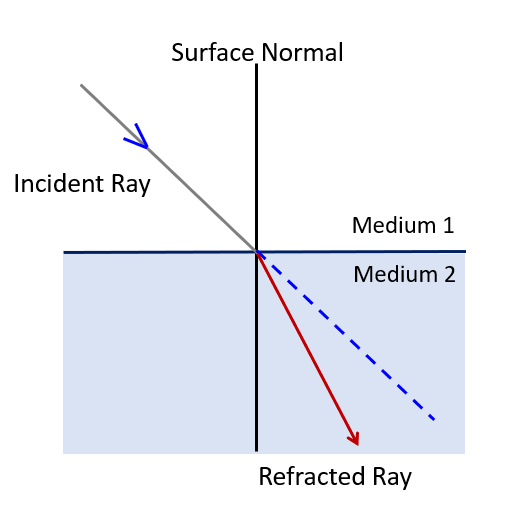
The phenomenon of refraction of light is shown when light passes between the two mediums.

You can see in the accompanying diagram that the light, which would have normally followed the blue line, became distorted and ended up following the red line. The initial light ray, shown in grey, is referred to as the incident ray, while the light ray in red is referred to as the refracted ray. Which way does light bend next? is a question that might come to mind. The solution is a generalisation: light bends toward the surface normal if the second material’s refractive index is higher. If not, it refracts differently from the norm. The difference in the media’s refractive indices determines the degree of bending.

Definition of Atmospheric Refraction

The phenomenon of atmospheric refraction occurs when light from space that enters the atmosphere travels in a curved path rather than a straight line. This intriguing finding has a simple explanation for its origin. It is well known that air does not have a constant density. It alters with height instead. As a result, the refractive index is lower near the top of the atmosphere, where air molecules are further apart. The refractive index rises when density falls, and vice versa.

Atmospheric Refraction

Light continuously bends while propagating through our atmosphere as a result of this gradient-like characteristic, leading to a curved path rather than the expected straight line. You can see in the image above how the blue light rays take a curved course as they move through the various layers of air.
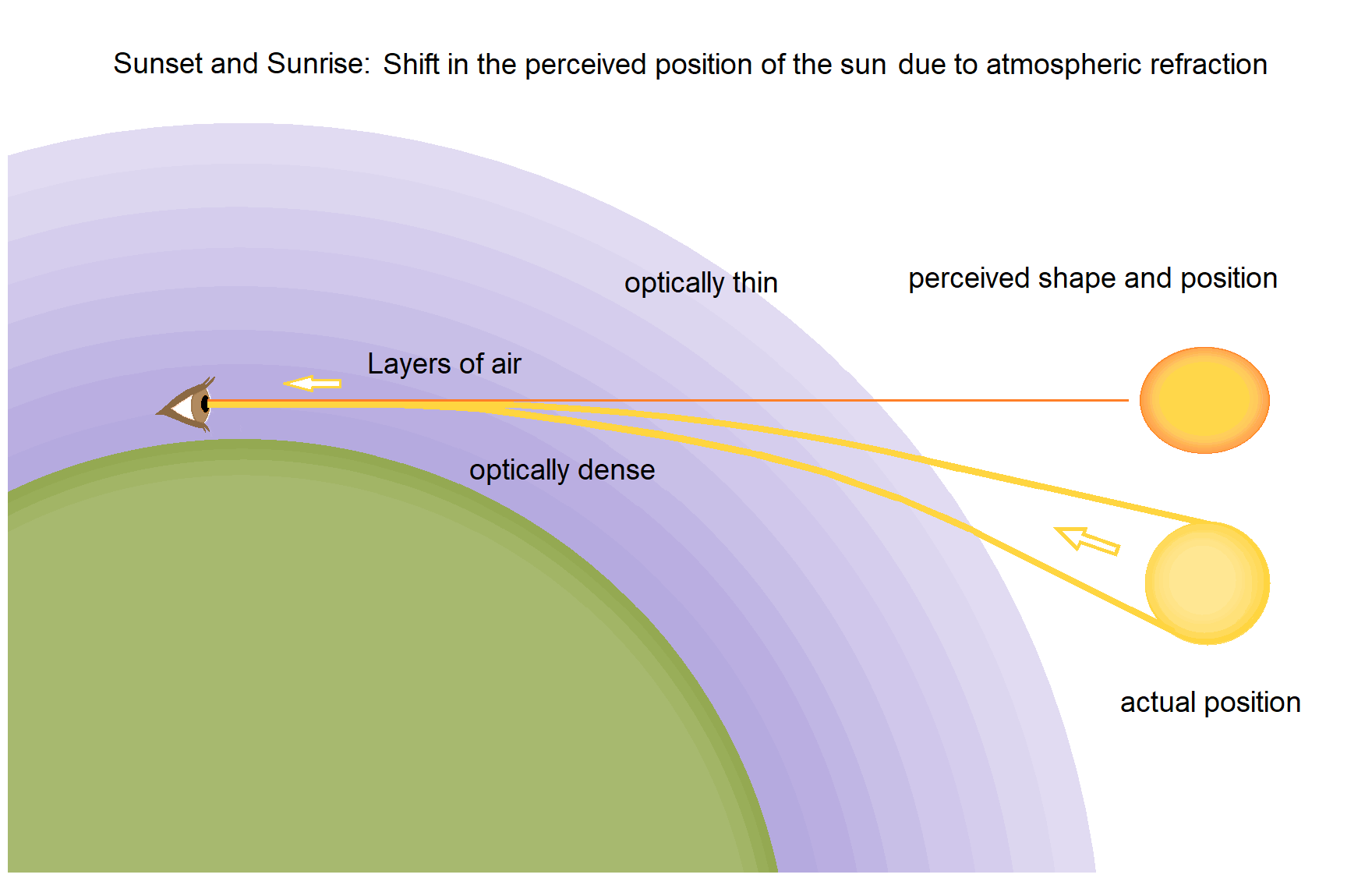
The phenomenon of Atmospheric refraction of light.

The explanation for Advanced Sunrise

Not all of the sunlight that strikes the earth’s atmosphere is absorbed by it. It is somewhat reflected in space. Think of viewing Earth from the international space station. You’ll notice that it seems brilliant and sparkling as a result of the earth’s atmosphere reflecting sunlight. Atmospheric reflection is the term for this phenomenon. Let’s talk about two typical consequences of atmospheric refraction: an earlier sunrise and a later sunset.

In the summer, sunrise in New Delhi, the capital of India, happens about 05:30 AM. On the other hand, if you were to stand on a rooftop and face east, you would notice that the sun rises roughly two minutes earlier. Why does that happen? Spend a moment trying to guess the solution.

The explanation is quite straightforward. The sun must be at a certain height above the horizon for light beams from it to reach your eyes, which can only happen when the sun is visible. because air’s refractive index varies, which causes the light to travel in a curved path.
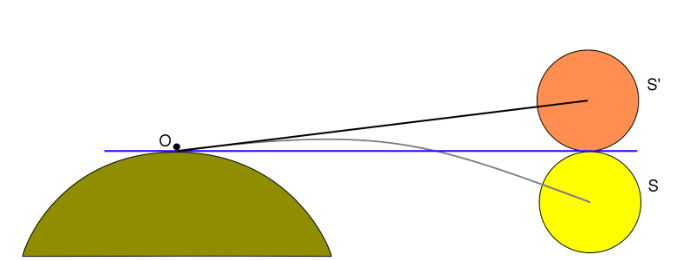
A schematic for the phenomenon of advanced sunrise

Since sunlight falling on the atmosphere continuously bends as it reaches the earth, you may see the sun even when it is just below the horizon. The sun is not actually in the position it appears to be in when you view a sunrise. Simply put, it just appears a little higher due to the curve in the path of the sun.

The explanation for Delayed Sunset

The sun has set, which means that you can no longer see it. It has descended so low on the horizon, in other words, that light cannot enter your eyes anymore. However, even after the sun has passed the horizon due to atmospheric refraction, sunlight is still visible for a few minutes. We refer to this as a delayed sunset. As with advanced sunrises, the curved path of sunlight in the atmosphere is the cause of delayed sunsets as well.

Summary

Refraction is defined as the change in direction of propagation of light when it encounters a change in refractive index. It is observed whenever there is some sort of inhomogeneity in the medium or the path of light. When light moves in the direction of an area with a higher refractive index, it bends in the direction of the normal. Our atmosphere’s refractive index is higher close to the earth’s surface than it is farther away because it also contains a density gradient. Thus, as light travels to the earth’s surface, it continuously curves into a path. The term for this is atmospheric refraction. The sunrise appears to happen a few minutes earlier than usual due to atmospheric refraction. Similar to this, the sun is still visible after it has actually crossed the horizon, delaying sunset. Both of these events take place because atmospheric refraction makes the sun appear to be a little bit higher in the sky than it actually is.

Frequently Asked Questions

1. State the laws of refraction.

Ans. When light passes from one medium to another medium with different refractive indices, two laws of refraction are followed:

1. The incident ray, the refracted ray, and the surface normal all together lie in the same plane.

2. The ratio of the sines of angles of incidence and refraction is equal to the ratio of refractive indices of the materials.

2. By what amount does light bend due to refraction?

Ans. According to the second law of refraction also named as Snell’s law, we can write a relation between the incidence and the refraction angles, such that,

$$
\frac{\sin \theta_i}{\sin \theta_r}=\frac{n_2}{n_1}
$$

Therefore, if we know the angle of incidence and refraction, and refractive indices of the two different mediums, we can calculate the angle of refraction. 

3. What other phenomena occur due to atmospheric refraction?

Ans. The phenomenon of mirage and twinkling of stars are the two very common natural examples of the effects of atmospheric refraction. 

4. Does the amount of refraction depend upon the colour of light?

Ans. Yes, the refraction of light depends upon the wavelength, and the colour of light depends upon the frequency. The refractive index that a beam of light “sees”, or “experiences” depends upon its wavelength. 

5. Which colour of light bends the most?

Ans. The Cauchy’s equation, refractive index $$
n=A+\frac{B}{\lambda^2}+\frac{C}{\lambda^4}+\ldots,
$$

where λ is the wavelength of light, and A, B, and C are constants. Thus, from the above formula we can speculate that the light of smaller wavelength, or higher frequency will bend more. This corresponds to violet light in the visible region, which bends the most.

Accelerometer

Introduction

An accelerometer is a tool used to measure the acceleration of a body. We are able to monitor and analyse both linear and angular acceleration using the accelerometer’s sensor. This function is used by us in many aspects of daily life and is a requirement for many fundamental systems and gadgets. An accelerometer, which measures numbers in one, two, or three planes, can be used to measure the acceleration force, or “g.” When the threshold is reached, a routine may start. Capacitive accelerometers, piezoelectric accelerometers, and piezoresistance accelerometers are the three basic types of accelerometers. Both inertial navigation and guidance systems make extensive use of them.

88guru book a Free demo class small imagelead magnet

What is an Accelerometer?

An accelerometer is a sensor that allows us to track both linear and angular acceleration. This function is used by us in many aspects of daily life and is a requirement for many fundamental systems and gadgets. Static forces and dynamic forces are the two categories into which acceleration forces are divided. Static forces are those that can be constantly applied to an object, such as friction or gravity. Dynamic forces are those that can be described as “moving” and are applied to the object at various rates (for instance, vibration).

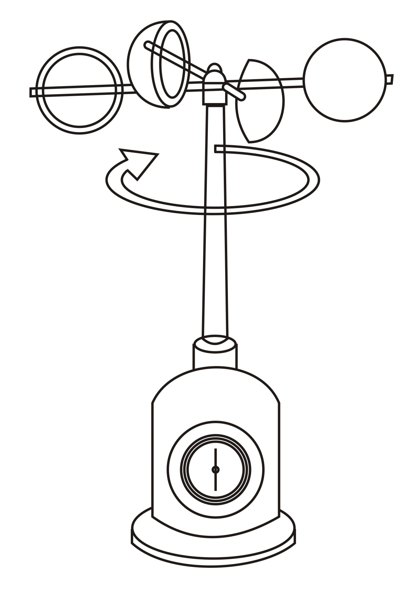
A schematic diagram of Cup Anemometer

How does an Accelerometer work?

  • The accelerometer operates on a very straightforward principle. An accelerometer, which measures numbers in one, two, or three planes, can be used to measure the acceleration force, or “g.”
  • If the threshold is exceeded, it can trigger a routine. 
  • The three-axis accelerometer, which features a system made up of three different accelerometers, is the most often used type of accelerometer. Each one calculates the acceleration in the X, Y, and Z planes in a separate direction.
  • One of the popular models of a 3 axis accelerometer is the OKYSTAR OKY3230 type. The accelerometer will only estimate the force of gravity as the standard when it is in a stable position, which is when there is no external acceleration experienced by the accelerometer.
  • Now, if we take a look at a three axes accelerometer and put it in a position where the sensor on the X axis points in the left direction, the Y axis points down, and the Z axis points forward, then the accelerometer will present the reading that is as follows:

$X=0 g, Y=1 g, Z=0 g$

88guru book a Free demo class small imagelead magnet

Purpose of accelerometer

An accelerometer is a device used in vehicles to measure the acceleration motion brought on by either motion or gravity. The accelerometer’s primary function is to transform mechanical motion into electrical impulses.

Capacitive accelerometer

A capacitive accelerometer measures an object’s acceleration by monitoring changes in electrical capacitance. The most popular accelerometer is this one.

  • Comparing the capacitive accelerometers to the other two types of accelerometers, they are the smallest and least expensive.
  • Its name implies that it is a micro-electro mechanical system, and its parts range in size from 1 to 100 micrometres.
  • The primary mechanism by which the capacitive accelerometer operates relies on the movement of a known mass suspended on springs. The mass is attached to one end of the spring, and the capacitor is attached to the other.
  • When the sensor is subjected to a force, the mass moves, changing the capacitance of the capacitors and, in turn, the distance between their plates.
  • However, for a variety of high amplitude signals and frequencies, this accelerometer’s accuracy is lower than that of other types of accelerometers.

Piezoelectric accelerometer

Using the piezoelectric effect, piezoelectric accelerometers can identify changes in acceleration.

  • The working principle is similar to the piezoresistive one.
  • When a material, often PZT, is subjected to acceleration, a deformation occurs that results in a change. But in this instance, it’s electric charge rather than resistance.
  • Piezoelectric accelerometers have a very high sensitivity and accuracy, making them suitable for widespread application.
  • They can be used for crash and impact tests in challenging conditions as well as for obtaining particularly sophisticated and accurate seismic estimation.

Piezoresistance accelerometers

As the pressure exerted on the piezoresistance accelerators increases, so does their resistance.

  • As compared to piezoelectric accelerometers, these are far less sensitive.
  • These accelerometers make use of the piezoresistive effect, a phenomenon that occurs when mechanical stress is applied and causes a change in a semiconductor or metal’s electrical resistance. An electrical signal is then produced by the accelerometer from the change.

Applications of accelerometer

An accelerometer is a piece of equipment used to measure a body’s acceleration. Both inertial navigation and guidance systems make extensive use of it. Other typical applications for accelerometers include:

  • It plays a crucial role in the airbag deployment system of contemporary cars.
  • It can be used to gauge seismic activity, vehicle velocity, or even inclination.
  • It can be used to gauge how deeply to compress the chest during CPR.
  • It can also be used to rotate the screen of a digital camera or a smartphone while displaying the images on the screen in an upright position.
  • In a variety of modern electronics, accelerometers are crucial and active components.

Summary

An accelerometer is a sensor that allows us to track both linear and angular acceleration. The accelerometer operates on a pretty straightforward principle. An accelerometer, which measures numbers in one, two, or three planes, can be used to measure the acceleration force, or “g.” Capacitive accelerometers, piezoelectric accelerometers, and piezoresistance accelerometers are the three basic types of accelerometers. Accelerometers are used in a wide variety of scientific applications. The inertial navigation systems are most frequently used for aircraft or missiles.

88guru book a Free demo class small imagelead magnet

Frequently Asked Questions

1. What is a gravimeter?

Ans: An accelerometer is known as a gravimeter when it has been expressly designed to be used in gravimetry, or to measure gravity.

2. What is the most common use of accelerometers?

Ans: Accelerometers are used in a wide variety of scientific applications. The inertial navigation systems are most frequently used for aircraft or missiles.

3. What are MEMS accelerometers?

Ans: Micro-electromechanical systems, or MEMS, are able to sense vibrations even at extremely small scales. To track changes in these electrical devices’ positions, they are mostly employed in a variety of portable gadgets.

4. How can an accelerometer be used for hard drive protection?

Ans: When a device experiences excessive acceleration or vibration, an accelerometer can identify it. It safeguards the hard disc in this case by emptying the reading heads to prevent contact with the pattern.

5. What are the key characteristics we need to keep in mind while selecting an accelerometer?

Ans: The sensor bandwidth, sensitivity, frequency response, and dynamic range of an accelerometer are some of the important properties we must take into account for a particular application.

Factors on which the Resistance of a Conductor Depends

Introduction

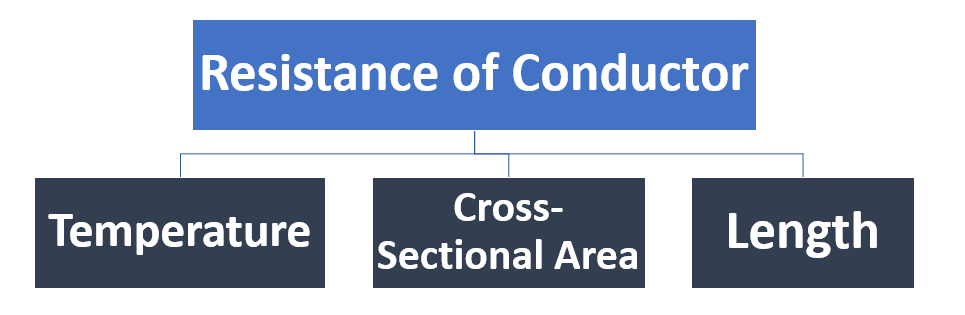
A conductor’s ability to resist the flow of electric current through it is known as resistance. Resistors are parts that are used to stop the flow of electrons. Due to the attraction between positive particles and negative electrons, the positive conductor particles obstruct the passage of electrons. The flow of electricity is resistant as a result of this obstruction. Ohms are the units used to measure resistance. There are two categories of electrical resistance: static resistance and dynamic resistance. The length of the conductor, cross-section area, temperature, material, etc. are the parameters that affect or depend on resistance.

lead magnet

Resistance of Conductor

Resistance is defined as a conductor’s ability to obstruct the passage of current. The conductor’s resistance is expressed mathematically as the relationship between the current flowing through it and the potential difference along its length.  The movement of electrons across a conductor is known as electric current. Because of their attraction to one another, positive conductor particles obstruct the flow of electrons, which results in resistance to the movement of electricity. Resistance can be used to disperse voltage in a current as well as control the flow of electrons.

The resistivity of the conductor depends on

The ability of a material to resist electrical conduction is known as its resistivity. Resistivity is utilised to offset the effects of size on resistance. It is a non-size dependent material attribute. The resistivity of a conductor is influenced by elements such as temperature, alloying, cold work, age hardening, and mechanical stress. For most materials, resistance rises with temperature. Semiconductors are an exception, as their resistance increases with temperature.

Resistance also depends on the temperature of the conductor. As the temperature increases the resistivity increases.

\[R{\rm{_T}} = {\rm{ }}R{\rm{_0}}(1{\rm{ }} + \alpha \Delta T)\]

R = final resistance, \(R_0\) = initial resistance, and α = temperature coefficient 

Check out our Science tuition to strengthen your Science concepts. Study Science Topic for classes 6th,7th, and 8th.

Resistance depends on temperature

The thermal energy of electrons rises with the temperature of metal conductors, which also raises the frequency of collisions between free electrons. As a result, they begin to move randomly, making it challenging to drift for conduction in a specific direction. The conductor’s resistance increases as a result. As a result, resistance rises as temperature rises for a metal conductor. Increasing current frequently results in temperature rise.

Conductor resistance formula

The resistance of a conductor is directly proportional to the length of the conductor (l). Thus, on doubling its length, resistance will be double, while on halving its length, resistance will be half. Also, the resistance of a conductor is inversely proportional to its cross-section area (A).

Since, \[R\propto L\]

And, \[R\propto \frac{1}{A}\]

Hence, \[R\propto \frac{L}{A}\]

Or, \[R = \rho \frac{L}{A}\]

Where R is resistance in ohm, L is length or conductor in meter, A is cross-section area in square meter and ρ is the resistivity constant in ohm per meter.

The bigger the value of resistance, the more it opposes the current flow. The value of resistance is given in Ω.

Temperature effect on resistance

A material’s resistivity changes with temperature. Resistance varies depending on the conductor, semiconductor, and insulator’s temperature. Resistance is influenced by temperature in two different ways: for metal conductors, it rises as the temperature rises, and for insulators, it falls as the temperature rises. At high temperatures, semiconductors have great conductivity.

Resistance of a Conductor.
Solved Problems

Problem 1: What is the resistance of the circuit having length 10 cm and area 100 cm$^2$ having resistivity of 1.8 Ω.m?

Solution:

Length of circuit = 10 cm

Area of circuit = 100 cm$^2$

Resistivity = 1.8 Ω.m

The Formula used,

\(R = \rho \frac{L}{A}\)

\(\Rightarrow R = 1.8~\Omega.cm \frac{10~cm}{100~cm^2}\)

\(\Rightarrow R = 0.18~\Omega\)

Problem 2: What is the cell constant of the circuit when the conductivity is 20 Siemens/m having resistance 100 Ω?

Solution:

Resistance = 100 Ω

Conductivity = 20 Siemens/m

Cell constant =?

The Formula used,

\(R = \frac{Cell Constant}{Conductivity}\)

\(\Rightarrow Cell~Constant = Conductivity \times R\)

\(\Rightarrow Cell~Constant = 20~Siemens/m \times 100~Ω\)

\(Cell~Constant = 2000~m^{-1}\)

lead magnet

Frequently asked questions

1.What is the importance of resistance in electricity?

Ans: Resistance is a crucial component of electrical circuits; as resistance increases, current flow becomes more challenging, and as resistance decreases, current flow becomes easier. The resistance is a crucial component in conduction. Conduction greatly benefits from electron flow. The conductor turns into a semiconductor and an insulator as a result of an increase in resistance.

2. Do conductors have high or low resistance?

Ans: Insulators have a very high resistance to electrical current, compared to conductors’ extremely low resistance. Resistance turns become an insulator as it rises. Since there is no interruption to the high flow of electrons, the conductor’s resistance is very low. Conduction and resistance are inversely correlated.

3. Is it a light bulb resistor?

Ans: Despite not actually being resistors, light bulbs exhibit resistive behaviour. Electrons cannot pass through resistors, which also transform energy into another form. The process by which electricity passes through a light bulb to produce light and heat is the same. The light bulb’s filament serves as a resistor. The law of conservation of energy states that as energy cannot be created or destroyed, it can only be transformed from one form to another.

Natural Fibres

Introduction

Natural fibres are fibres derived from plants and animals that have a wide range of applications in the production of composite materials. Most natural fibres are thought to be effective sweat and moisture absorbers, and different natural fibres can provide a wide range of textures.

What are Fibres?

Fibres are materials used in the production of textiles such as clothing and cables. All textiles contain natural or synthetic fibres. Natural fibres are made from natural sources such as animals and plants. Synthetic fibres are created through chemical synthesis.

Types of Fibres

1. Synthetic Fibres

Synthetic fibres, also known as man-made or artificial fibres, are manufactured through chemical synthesis and were first developed in the nineteenth century.

image of artificial synthetic fibres

2. Natural Fibres

Natural fibres are derived from animals and plants, and they are frequently treated and spun into yarn before being turned into a product.

Type of Natural fibres

Examples of Natural Fibres

  1. Cotton is derived from cotton seeds and is widely used in textiles. It is extremely lightweight, making it an ideal fibre for garment fabrics, and this has increased consumer demand.
  2. Silk is derived from an insect and is the material used to make a cocoon.
  3. Jute is a stronger fibre than cotton and jute, derived from plants, and it is used to make sacks and other packing materials.
  4. Wool is derived from sheep and other hairy animals and is used to make fabrics due to its ability to retain heat. Wool is also a popular clothing fibre because it is preferred by people who live in cold climates.

Check out online study options are a great way to clear the science concepts you need. Study Science tuition for classes 8th Lesson 3.

Advantages of Natural Fibres

  1. Natural fibre clothing is significantly more pleasant to wear than synthetic clothing, especially during the summer, when people sweat more and just need clothing made of breathable materials that can soak the extra water.
  2. Natural fibres are excellent insulators because they can trap air between them, preventing them from escaping into the atmosphere. This air, which is captured in the fabric’s microscopic holes, provides warmth and helps keep a person’s body temperature constant even in cold weather, which is why many skiers, hikers, and other people who live in cooler environments prefer to wear silk or wool.

The disadvantages of Natural Fibres

  1. Natural fibres are generally more expensive than synthetic fibres due to their qualities as a wonderful insulator, being much more sustainable, and much more comfortable to wear, and because they are retrieved directly from the environment, the cost of producing them is often higher than the price of producing synthetic fibres.
  2. Natural fibre production is not always completely under human control, and nature is autonomous and does not work by human requirements and aspirations. Natural disasters and tragedies have a significant impact on availability, causing significant variations in supply and price.

Summary

Natural fibres can be derived from both plants and animals and are used in a wide range of composite material production processes. Wearing natural fibre clothing is more comfortable than wearing synthetic fibre clothing. Synthetic fibres, which are produced through chemical synthesis, are also referred to as artificial fibres. 

Frequently Asked Questions

1. Why are natural fibres such good insulators?

Ans. Natural fibres can trap air between them, preventing them from escaping into the atmosphere. Even in extreme cold, the trapped air keeps a person warm and regulates their body temperature. Because of this, natural fibres are said to be excellent insulators.

2. Why are synthetic fibres so simple to make?

Ans. Synthetic fibres can be produced in greater quantities and at a lower cost than natural fibres, as well as faster in a factory.

3. What advantages do cotton fabrics have over synthetic fabrics?

Ans. Synthetic fibres are not suitable for hot and humid conditions because they do not absorb sweat as well as cotton garments, but cotton garments do. The cotton cloth absorbs water quickly and burns at a low temperature.

Formation Of Fossil Fuels

Introduction

Fossil fuels are hydrocarbon (compounds of carbon and hydrogen)-containing substances that form naturally (in nature) on the earth’s surface (earth’s crust). They are made up of the remains of dead (not alive) plants (flora) and animals (fauna) that are extracted (absorbed) and buried under the soil before being burned as fuel. Coal, petroleum, and natural gas are examples of well-known and widely used fossil fuels (or fuels). Coal seams are rock strata (stone) that form coal (charcoal) seams. When dead (not alive) plant matter (flora) decays (decomposes) into peat (an accumulation of partially decayed organisms), it is converted (transformed) into coal (charcoal) by heat (H) and pressure (P).

lead magnet

There are four stages involved in coal generation or formation: 

  1. Peat 
  2. Lignite 
  3. Bituminous 
  4. Anthracite

These stages (steps) are determined by the conditions in which they were buried. Coal has many applications in our lives, including home and commercial heating, the production of medicines and tars, and so on. Petroleum (also known as crude oil) is formed or produced from the decomposing remains of ancient marine organisms like bacteria, plants, and algae. Petroleum is used to produce heat and electricity, as well as a lubricant.

Let our expert Guru be your guide toward improving your grades and reaching your highest potential. Study Science curriculum for classes 8th Lesson No. 5

What exactly are fossil fuels?

Fossil fuel is a type of hydrocarbon-containing substance that occurs or is produced naturally on the earth’s surface from the dead remains of plants and animals, which are extracted and burned as fuel. Coal, petroleum, and natural gas are three of the most common and widely used fossil fuels. Fossil fuels are sometimes burned to provide heat for direct use in cooking and heating. Additionally, fossil fuels are used to power engines and generate electricity.

The anaerobic decomposition of buried dead organisms containing organic-type molecules generated by photosynthesis is the origin of fossil fuels. And the conversion of these substances to fossil fuels necessitates or is the result of a geological process that takes millions of years. Fossil fuels are extremely important for humanity and development because they can be easily burned in the open atmosphere to produce heat. However, the excessive use or exploitation of fossil fuels by humans is also very harmful to the environment.

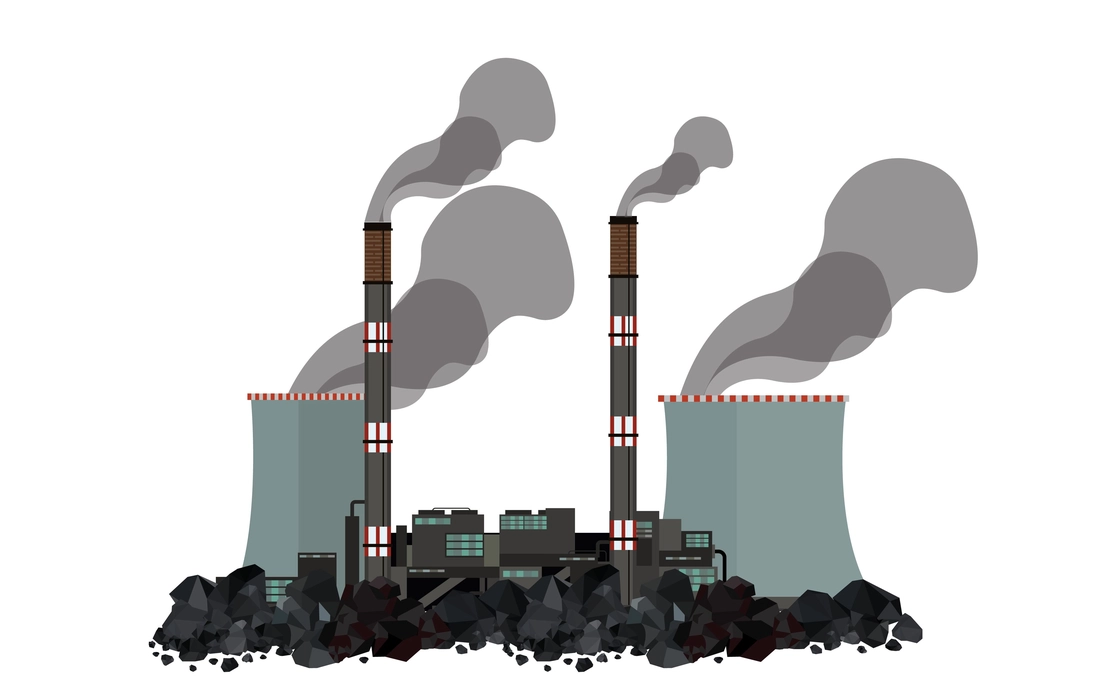
Fossil fuels power station

How Is Coal Made?

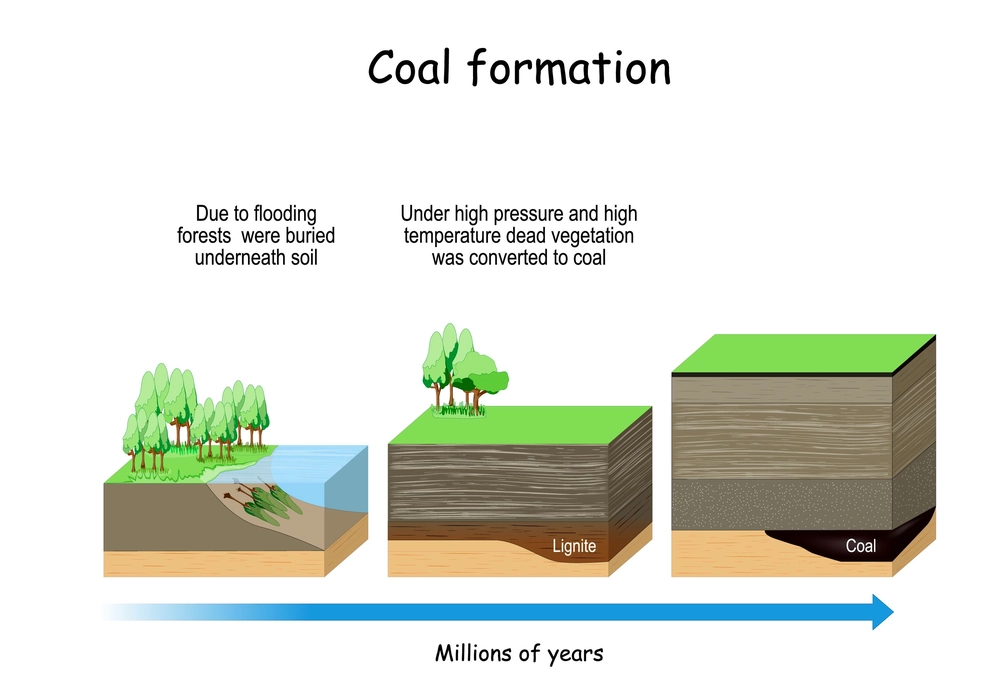
Coal is a black, solid, combustible fossil fuel. Coal contains a significant amount of carbon. Coal formation is a slow and gradual process that takes millions of years. And coal formation begins or begins in muddy wetlands where groundwater is near or slightly above the topsoil. Because of this condition, the flora presents there produces organic matter at a faster rate. The layers of organic materials are then accumulated and buried. These layers combine to form coal. The energy in coal is derived from sunlight, which is harvested by dead plants.

Although there are two major stages in the formation of coal, they are peatification and coalification. Peat (accumulation of partially decayed organisms) formation occurs as a result of bacterial activities, and the main factors in coalification are exceeding temperature and pressure from burial.

Coal Formation image

Coal Formation Stages

There are four stages in the coal formation and, they are peat, lignite, bituminous, and anthracite. These stages are determined by the conditions to which the remains (plant) are subjected (forced) after being placed inside or buried. The higher the ranking of coals, the greater the amount of heat and pressure applied.

  1. Peat is the first stage in the formation of coal. In general, plant matter is oxidized to carbon dioxide (CO2) and water (H2O). However, if plant materials accumulate underwater (inside the water), oxygen (O2) is not available or present, and only partial (slight) decomposition occurs. This incomplete (partial) destruction (decomposition) results in the accumulation of peat, an organic (natural) substance (material).
  2. The lignite-The second stage of coal formation, in which peat (first step) is subjected (forced) to increase vertical pressure (p) from collecting sediments. It is widely available, but it is only used as coal when a more (higher) efficient fuel (fossil) is unavailable.
  3. Bituminous-The third stage in the formation of coal. Adding pressure, compacting (small area), and virtually (mostly) all traces of flora (plant life) have vanished or vanished. This type of coal can be found in Cape Breton and is also present in our most abundant fuel.
  4. Anthracite-This is the fourth and final stage in the formation of coal. This is also known as ‘hard coal,’ because it is hard (strong) and has a high luster. The combination of high pressure and temperature causes this to form.
lead magnet


Coal Applications

  1. Coal is used for a variety of purposes, including domestic and industrial fuel.
  2. Electricity is generated or produced using this device.
  3. It is also used as a fuel in automobiles.
  4. It is used in the manufacture or preparation of cement, carbon fibers, medicines, and other products.
  5. Furthermore, it’s also used in the steel industry to make steel and other metals.

Summary

Fossil fuel is a type of hydrocarbon-containing substance that occurred or is produced naturally on the earth’s surface from the dead remains of plants and animals, which are extracted and burned as fuel. Coal, petroleum, and natural gas are three of the most common and widely used fossil fuels. Fossil fuels are sometimes burned to provide heat for direct use in cooking and heating. Additionally, fossil fuels are used to power engines and generate electricity.

Frequently Asked Questions (FAQs)

1. What exactly do you mean by “fossil fuels”?

Ans. Fossil fuels are hydrocarbon-containing substances (materials) that formed naturally (in nature) on the earth’s surface (earth’s crust). They are made up of the remains (leftovers) of dead plants and animals that are extracted, buried, and burned as fuel.

2. What causes the production of fossil fuels?

Ans. The anaerobic (in the absence of oxygen) decomposition of buried dead organisms is the origin (point of generation) of fossil fuels (plants or animals).

3. Name the stages of coal formation.

Ans. The four stages of coal formation are peat, lignite, bituminous, and anthracite.

Atoms & Molecules

Introduction

There is matter in our universe. The matter is anything that maintains a quantity and a space. These things have a fundamental unit that cannot be divided into other parts with various chemical and physical properties. An atom is this fundamental component. An element is a substance that only contains one type of atom. Therefore, the species made up of a specific atom are the elements. For instance, there is only one type of atom in pure platinum metal. The atom was once thought of as an indivisible unit, but now it can be divided, releasing a huge amount of energy in the process.

Define an Atom and Molecule

An atom is the tiniest component of matter. The physical and chemical characteristics of the atoms that make up an element are all the same type. An atom is mono-nuclear, meaning that it has just one nucleus, which is surrounded by electrons and houses protons inside the central mass of the atom, the nucleus.

Chemical bonds bind the minimum required number of atoms in a molecule together. It is the joining of various atoms with the assistance of a chemical bond. The molecule oxygen\(\;({O_2})\) is a diatomic homo nuclear structure made up of two oxygen atoms bound together by a covalent bond.

What is the size of an Atom?

Only an estimation of an atom’s size can be made because it is impossible to measure it precisely. However, an atom’s atomic radius determines its size. Atomic radius is calculated by dividing the distance between adjacent atoms in a compound by two. Radii come in a variety of forms, including metallic, covalent, and ionic radii. The metallic radius is the separation between adjacent atoms in a metal. The covalent radius is the separation between adjacent atoms in a covalent compound. Ionic radii are the distances between adjacent ions in an ionic compound.

How atoms are formed?

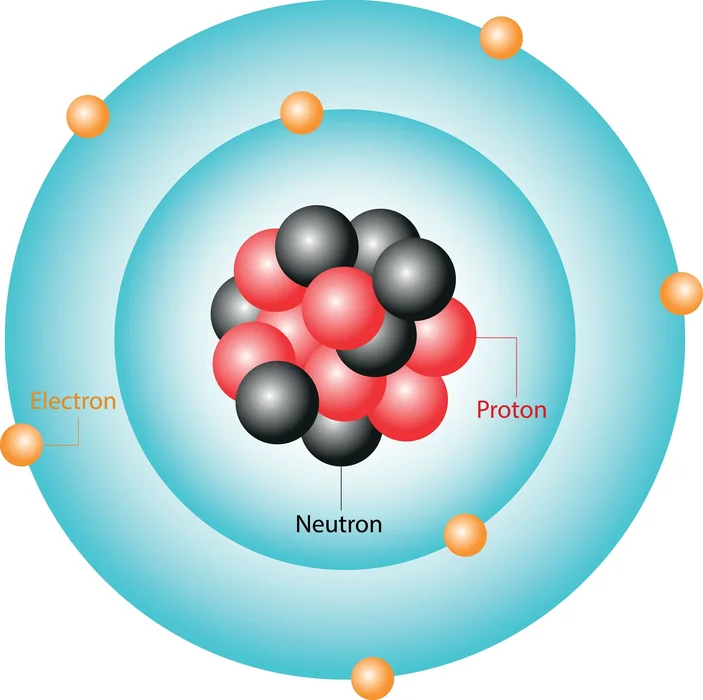
The atom is the smallest unit of matter, consisting of a nucleus and electrons. The nucleus is the central portion of the atom that contains the positively charged proton and neutral neutron. And is surrounded by electrons that are negatively charged. Protons, electrons, and neutrons make up an atom. They are collectively known as subatomic particles.

Forces between Atom and a Molecule

Molecules are formed when atoms are held together by a strong chemical bond. These bonds are formed by the interaction of an element’s valence electrons to complete the octet. Chemical bonds are classified into several types. They do,

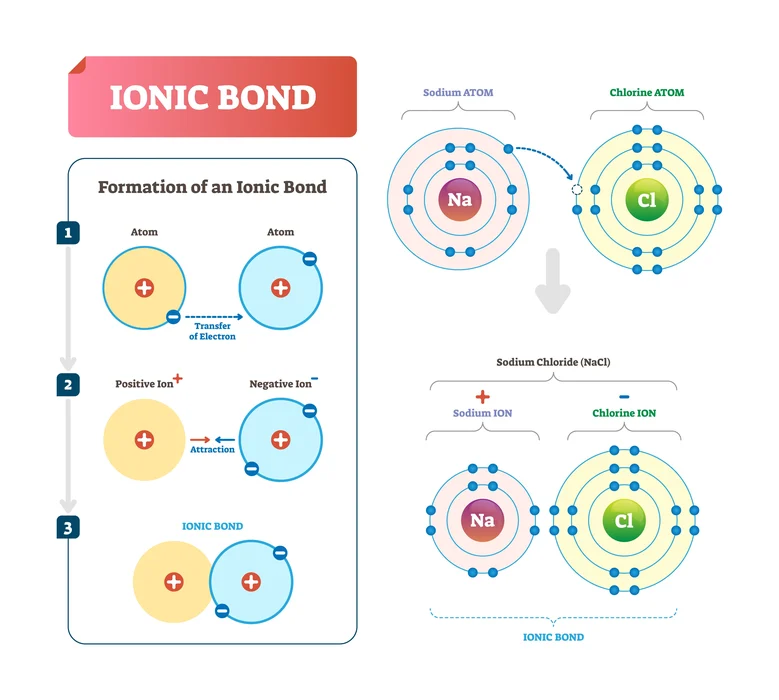
1.Ionic bond: When two atoms approach each other and have a large electronegativity difference, electrons, and anion forms are accepted. And the one that lost an electron will become an anion. An Ionic bond is formed as a result of the attraction caused by the positive and negative charge.

Image of formation of ionic bond

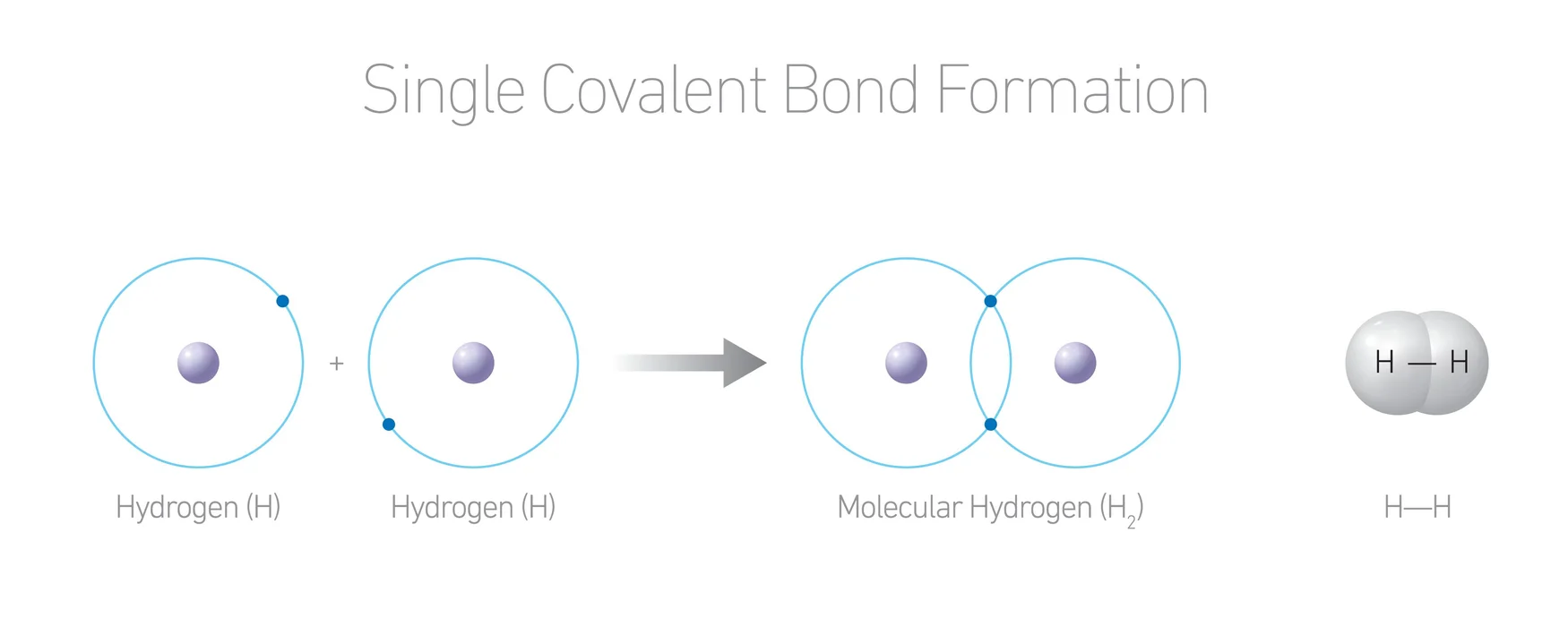
2.Covalent bond: When atoms with similar electronegativity differences approach each other, they share electrons. And this is a covalent bond.

image of Single covalent bond formation

Summary

Chemistry’s fundamental terms are atoms and molecules. Atoms are the fundamental building blocks of elements. A molecule is formed by the combination of different atoms using a chemical bond. These bonds could be covalent or ionic. Protons, neutrons, and electrons make up an atom. The size of an atom cannot be calculated precisely; only an approximation of size is possible. 

Frequently Asked Questions 

1. What exactly are isotopes?

Ans. Isotopes are atoms with the same atomic number but different mass numbers. The same atomic number denotes the same number of protons. And a different mass number means a different neutron number.

2. What is the mass number?

Ans. The mass number is the sum of protons and neutrons added to an atom of a chemical element. Lithium, for example, has a mass number of 7. Lithium has 3 protons and 4 neutrons.

3. What is the chemical formula?

Ans. A molecular formula is an expression used to represent a chemical compound that is the simplest whole-number ratio of the composition of elements present in a molecule.

Atomic Orbital

Introduction

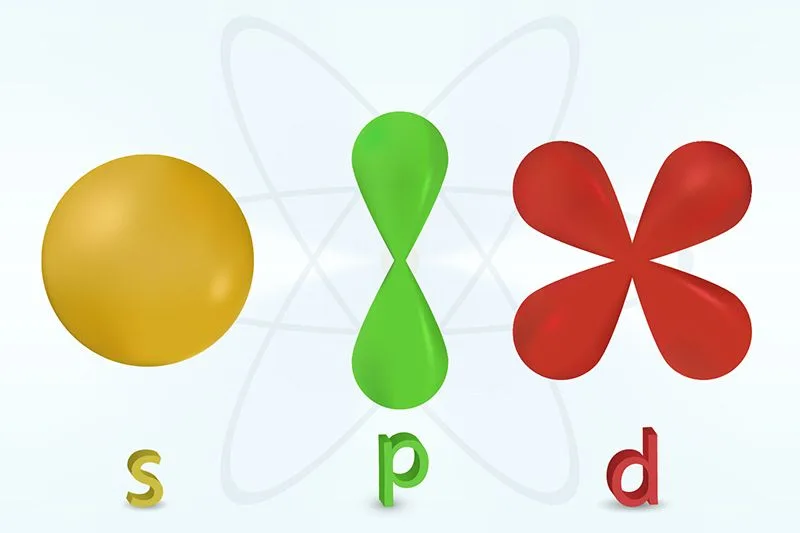
Atomic orbitals are the three-dimensional spaces that surround the nucleus and are most likely to contain an electron. The atomic orbitals have been combined to create molecular orbitals. They obtain orbitals in quantum theory, some of which are electron shells in the s, p, d, and f configurations. Although orbitals come in a variety of shapes and sizes, their square can be used to estimate their size or even shape. A total of two, six, ten, or fourteen electrons could fit in the s, p, d, and f subshells, respectively. The particular arrangement of electrons within orbitals in such an atom determines the majority of the chemical compositions of that atom. Depending upon the energy over its electrons, every orbital class seems to have a distinct form. The s orbital has a spherical geometry. The p orbital has the form of a dumbbell, as well as 3p orbitals, which vary in their arrangement across a 3-dimensional axis.

Image of  S,p,d atomic orbitals

Define Atomic Orbitals

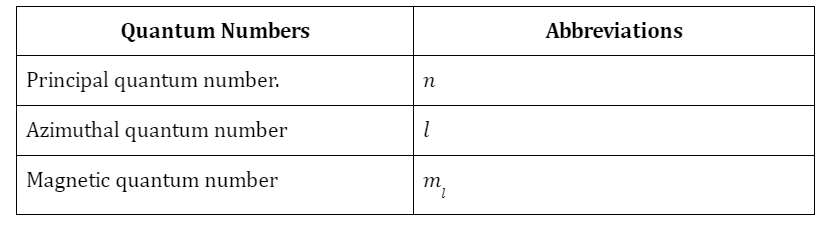
Atomic orbitals are numerical values that provide additional details about the waveform of electrons that inevitably surround atom centers. In the fields of quantum systems and atomic theory, specific mathematical expressions are frequently employed to determine the likelihood of detecting an electron at even a specific area surrounding the nucleus of an atom. The term “atomic orbital” may also refer to the region above an atom’s nucleus where there is the greatest chance that a particular electron will become accessible. Several quantum numbers affect each atomic orbital’s characteristics:

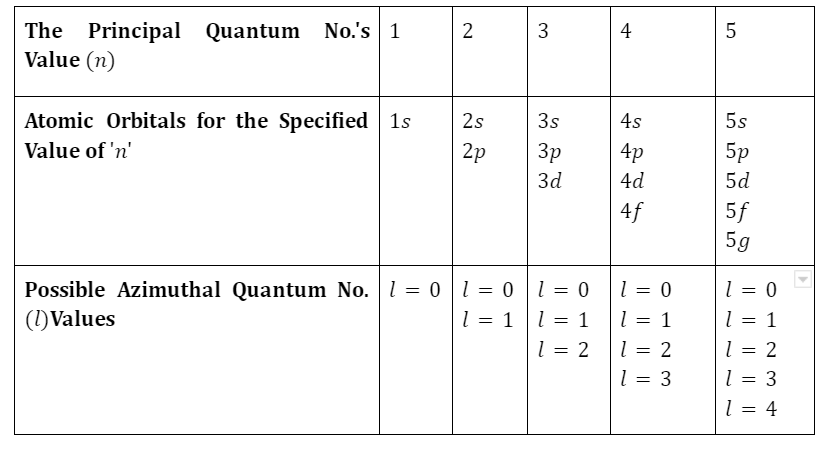
Table of All Possible Atomic Orbitals, where the Value of ‘n’ Ranges from 0 to 5

What do you mean by Atomic Orbital Theory?

An atomic orbital is a statistical term that describes the location or even waveform behavior of such an electron in an atom in both atomic theory and quantum field theory. These electrons, each of which has a distinct spin quantum number s, can fit into any one of these orbitals up to a maximum of two. One such formula can be used to determine whether it is possible to find an electron inside the nucleus of any atom at any particular location.

Summary

Atomic orbitals seem to be the regions around the nucleus of an atom where electrons have often been observed at that particular time. This is a mathematical concept that characterizes the wave-like activity with 1-2 electrons in an atom. Electrons inhabit low-energy orbitals (near such nuclei) before electrons approach higher-energy orbitals. When there is an option of equal-energy orbitals, then occupy the orbitals freely as feasible. That filling of orbitals on its own is termed Hund’s law when applicable. Atomic orbitals are typically denoted by a series of digits as well as letters representing unique features of such electrons linked only with orbitals, including 1s, 2p, 3d, as well as 4f. Primary quantum numbers are values that further indicate levels of energy.

Frequently Asked Questions (FAQs)

1. Is it possible to have an orbital without an electron?

Ans. An orbital’s characteristics are more like the electron residing inside it. This is standard procedure, however irrational this could appear, to refer to ‘Empty orbitals.’ The characteristics of unoccupied orbitals are the same as those computed for electrons within them.

2. What is perhaps the greatest number of orbitals possible?

Ans. The values n=3 & l=1 indicate that it has been a 3p-orbital, however, the number \(f(m_{l}=0)\) indicates that it is indeed a \(3p_{z}\) in origin. As a result, the specified quantum number can only identify one orbital, namely 3p_z.

3. How do electrons fill orbitals?

Ans. According to the Aufbau principle, electrons first occupy lower-energy atomic orbitals before moving onto the higher ones. Based on this method, we may forecast the electronic structure of atoms and ions.

Atomic Number & Mass Number

Introduction

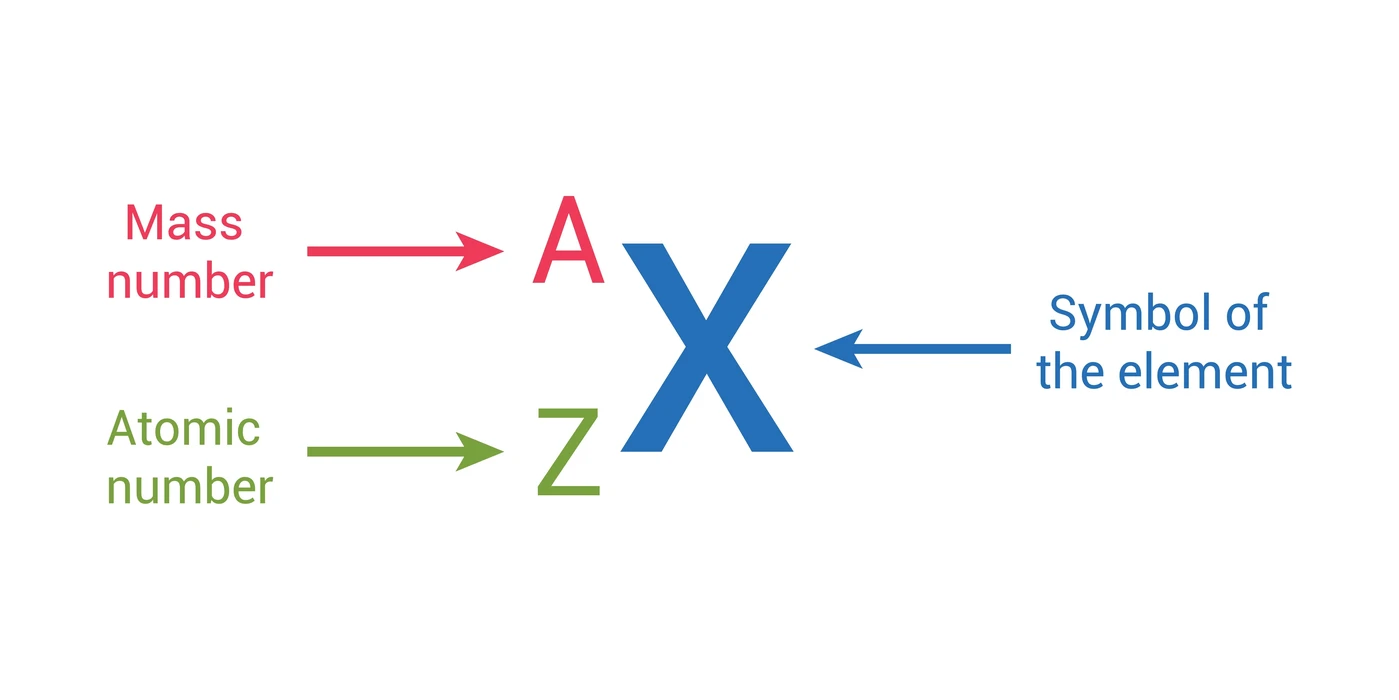
While the number of protons is merely the atomic number, the atomic mass of an atom is the sum of both its protons and neutrons. The letters A and Z can be used to denote these. Since it offers the key to the element’s existence, the atomic number is the concept that deals with such a periodic table element. It is only after interacting with this particular proton, which is primarily referred to as this hydrogen isotope’s protium, that the atomic and mass numbers are the same. Keep in mind, in particular, that while the atomic number remains constant, the mass number could change due to the presence of multiple isotopes. The elements are arranged in numerical order by atomic number.

image of Representation of an Atom with mass number and atomic number

Define Atomic Number

The number of protons in the nucleus of an atom is the atomic number. This is denoted by the letter Z. The number of electrons that surround the nuclei is controlled by the number of protons. In a periodic table with ascending atomic numbers, compounds with similar chemical properties typically cluster in the same column. Different elements have distinctive atomic numbers. For example, all C atoms have an atomic number of sixes, whereas all O atoms have an atomic number of eights.

lead magnet

Define Mass Number

Rutherford proved that an atom’s nucleus, which is composed of protons and neutrons, contains perhaps the majority of the atom’s mass. The mass number refers to the total number of protons and neutrons in such an atom. Atomic mass units are used to measure this. To represent it, the letter “A” is frequently used. This has typically been accomplished by simultaneously adding both neutrons and protons.

For instance,\(Cl^{37}_{17} \) appears to have a mass number of 37. Its nucleus contains twenty neutrons and seventeen protons.

What is the difference between Valency, Atomic number and Mass number

ValencyAtomic NumberMass Number
The greatest amount of electrons that even an atom could lose, gain, as well as share, in addition to getting stable is referred to as valency.An atomic no. is the no. of protons that exist in such an atom.The mass no. within an atom is the total of its protons as well as neutrons.
The electronic arrangement of such an atom could be used to evaluate its valency.The mass number has always been less than the atomic no.The atomic no. is always greater than that of the mass number.
The no. of atoms does not affect valency.No. of neutrons in an atom does not impact its atomic no.The no. of neutrons inside an atom seems to not affect the mass no.
The no. of electrons does have a direct relationship with valency.The atomic no. of isotopes seems to be the same.The mass number of isotopes varies.
Elements are classified as monovalence, divalence, and trivalence based on their valency.Isobars with similar atomic no. cannot exist.The mass no. of isobars would be the same.

Energy Levels of Atomic Orbital

When an electron reaches a certain energy level, it is more likely to be found in these regions than in other regions. Orbitals are the name for those sections. Orbitals with roughly similar energies have created sub-levels. The maximum capacity for each orbital is two electrons. The energy of such an electron in a specific atom may be determined solely by the primary quantum number. In order of increasing orbital energy are the following orbitals:

\(1s<2s=2p<3s=3p=3d<4s=4p=4d=4f\)

Summary

The mass number of an atom’s nucleus is an integer equal to the sum of the nucleus’ protons and neutrons. The atomic number, in contrast, is simply the number of protons. Even though their mass is so small compared to that of protons and neutrons, electrons are not counted when calculating mass because they have no impact on the value. The number of neutrons may change, even though the number of protons in such an element’s units remains constant. An electron appears to have very little mass. Therefore, an atom’s atomic mass is roughly equivalent to its mass no. The mass number represents the weight of an atom’s nucleus in atomic mass units.

lead magnet

Frequently Asked Questions (FAQs)

1. Is there a relationship between atomic mass and weight?

Ans: No, atomic mass is indeed the weight of an atom, while atomic weight denotes the weighted average of naturally produced elements.

2. Why does an atomic number refer to as a fingerprint?

Ans: The physical or chemical characteristics of an atom have been exclusively governed by the no. of electrons inside its nucleus, but often along with its nuclear charge: the nuclear charge would be an element’s specific “fingerprint,” as well as Z identifies the chemical components individually.

3. Why is it that a mass number is typically a whole number?

Ans: Since it is the total number of the particles, the mass no. is always a whole number. This varies from the atomic mass unit, which is well recognized, as well as written to 6 decimal points.

Bohr’s Atomic Model Postulates

Introduction

In 1913, Neil Bohr introduced the Atomic Model, which was based on Planck’s quantum theory of radiation. In overcoming the limitations of Rutherford’s atomic model and describing the hydrogen spectral lines. One such model appeared to be very effective in describing the atom’s stability, as well as the line spectra of an H atom. This model hypothesis correctly predicted smaller atoms such as hydrogen, but when larger atoms were observed, poor phantom assertions were made. However, it does not describe the Zeeman effect, atomic spectra, the Stark effect, or Heisenberg’s Uncertainty Principle.

An Overview of the Bohr Atomic Model

According to Bohr’s Atomic Model, an atom is made up of a tiny, positively charged nucleus surrounded by electrons that move in circular orbits all over the nucleus, attracted by electrostatic forces. He was also awarded the Nobel Prize in Physics for his contributions to atomic structure.

Bohr Atomic Model of a Nitrogen Atom.

The Bohr Atomic Model’s Postulates

1. Orbits are allowable circular trajectories in that electrons travel all over the nucleus.

2. Because each orbit was associated with a specific amount of energy, they were referred to as energy levels and energy states.

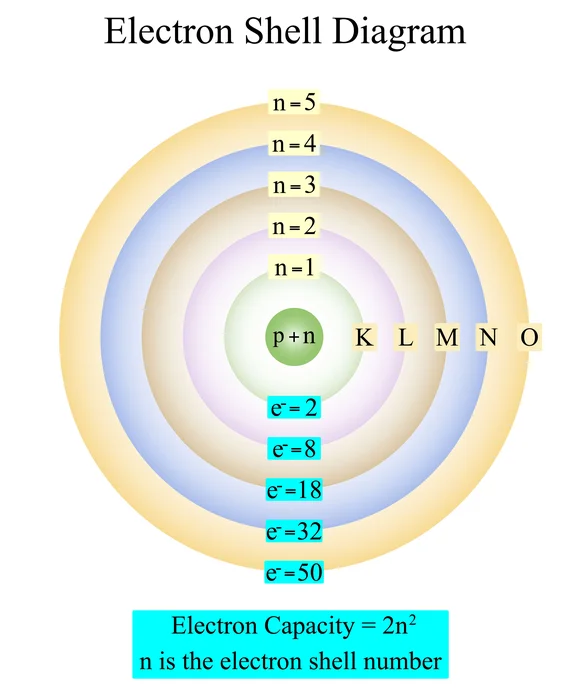
3. Shells of energy have been labelled as 1, 2, 3, 4,… or even K, L, M, N…., and so on. The energy level closest to the nucleus is denoted 1 and is known as the K shell.

4. When travelling at a certain energy level, an electron does not lose or gain energy. In such a given energy state, an electron’s energy appears to be fixed as well as stationary. This is referred to as the normal or ground state.

5. When an electron moves from one orbit to the next, it both emits and absorbs energy. When it travels from a higher energy state to a lower energy state, it releases energy, and when it travels from a lower energy state, it consumes energy.

6. Planck’s equation calculates the absorbed and released energy as the difference between the energies of the energy states.

Electron shell or a principal energy level may be thought of as an orbit followed by electrons around an atom's nucleus.

Bohr’s Atomic Model’s Limitations

1. Bohr’s concept did not explain the atomic spectrum of elements with more than one electron.

2. This does not account for the Zeeman effect, which occurs when a magnetic field breaks spectral lines into densely closed lines.

3. It also fails to illustrate the Stark effect, which occurs whenever spectral lines are broken into fine lines by an electric field.

4. According to Bohr, electrons’ circular orbits appear to be flat. However, a new study shows that an electron travels in 3 dimensions across the nucleus. Because light electrons have a dual nature, this would be centred on de Broglie’s idea.

5. Bohr’s atomic model would not adhere to Heisenberg’s uncertainty principle. According to this theory, determining the precise position and momentum of a tiny circulating particle like an electron with extreme certainty appears to be difficult. As a result, electrons follow a well-defined circular path.

6. Bohr’s hypothesis can never explain the shapes or the structure of molecules. This incorrectly considered large-sized atoms while providing sufficient information about smaller atoms.

Summary

Niels Bohr’s atomic theory includes definite-size electrons as well as energies travelling in orbits around a central nucleus, similar to how planets orbit the sun. To summarise Bohr’s atomic model, the energy states of electrons are focused on the size of such orbits. As a result, electrons in tighter orbits would have less energy. Atoms are unstable because electrons move to drive down orbits, resulting in radiation. Because the electron appears to have no lower orbit to which it can jump, an atom within the smallest orbit has now become completely stable. As a result, it was hypothesised that such an electron could move between these orbits by absorbing and losing photons.

Frequently Asked Questions

1. What exactly is the Bohr Atomic Model Theory?

Ans. Bohr was the first to discover not only that electrons revolve around the nucleus in distinct orbits, but also that the total number of electrons in an element’s outermost shell can be used to define its properties.

2. What is preventing atoms from collapsing?

Ans. The electrons of an atom are kept from collapsing within the nucleus by balancing kinetic and potential energy.

3. What is the radius of a Bohr orbit?

Ans. The Bohr radius, denoted by ‘r,’ has been defined as the mean radius of an electron’s orbit around the nucleus of an H atom in its initial state. Its radius has become a standard value, roughly equivalent to \({5.2917710^{ – 11}}m.\).

Calcination And Roasting

Introduction

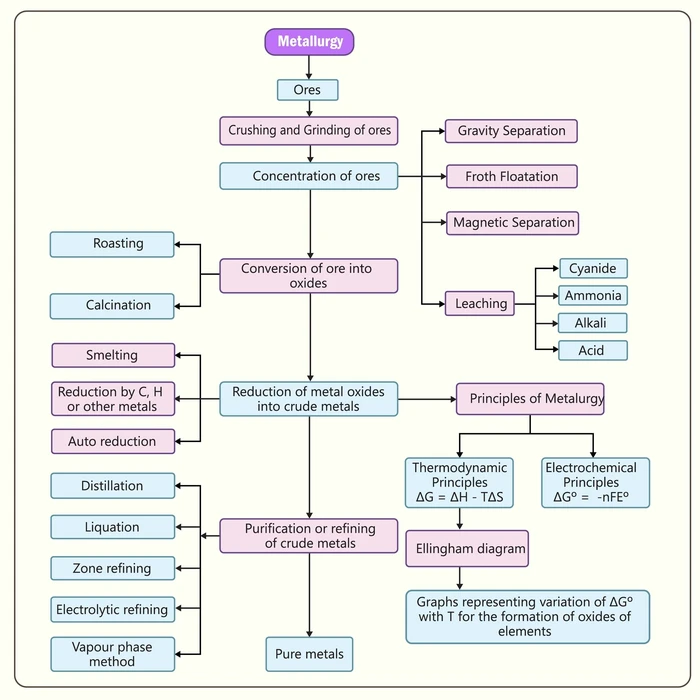
Calcination and roasting are two processes used to convert ores into oxides. Ores are a naturally occurring substance found in the earth’s crust. These ores are rich in minerals and valuable metals. Metals extracted from ore are required by applying lots of heat, either in the presence or absence of oxygen. Processes such as calcination and roasting are used to convert ores to oxides. The following is a step-by-step diagram for converting ores to oxide and extracting pure metals.

To produce oxide, raw ore is required. During this process of conversion, it expels volatile substances and gas. The removal of volatile impurities in solids and gases results in the extraction of metals from ores’ oxides. Furthermore, electrolytic refining purifies metal.

Flowchart of Metallurgy

What Exactly is Calcination?

It is the process of converting carbonate ore to oxide below its melting point using heat in the absence of air or with a limited supply of oxygen. It is also referred to as the thermal decomposition process because it decomposes ore or solid substances without changing their chemical properties and only removes volatile and organic impurities. As an example:

\[ZnC{O_3} \to {\rm{ }}ZnO{\rm{ }} + {\rm{ }}C{O_2}\]

How would you define Calcination?

Calcination is a thermal or heat process that occurs when a solid substance, such as carbonate ore, is heated above its melting point in the absence or limited supply of oxygen. Calcination is derived from the Latin word Calcinare, which means ‘to burn lime’. As a result, the most commonly used ore limestone (calcium carbonates) produces quicklime in the absence of air or oxygen at temperatures ranging from 900 to 1050 °C (calcium oxide). The following is my reaction:

\[CaC{O_3} \to {\rm{ }}CaO{\rm{ }} + {\rm{ }}C{O_2}\]

Why Calcination is Necessary

Calcination is a method of purifying ores. Heating ores or solids to temperatures well below their melting points causes the decomposition or removal of volatile impurities, moisture and water, and organic matter. As an example:

1. Carbon dioxide removal from carbonated ores.

2. Hydrated molecules are extracted from bauxite and gypsum. The following is the reaction:

\[A{l_2}S{O_3}.2{H_2}O{\rm{ }} \to {\rm{ }}A{l_2}{O_3} + {\rm{ }}2{H_2}O\]

1. The extraction of volatile liquids from petroleum and coke.

2. In the preparation of zeolites, ammonium ions are removed.

What Exactly is Roasting?

It is a process of converting mainly sulphide ores into their respective metal oxides when subjected to heat in the presence of air or oxygen. It is one of the metallurgical processes.

How would you define Roasting?

The heating process of converting sulphide ores into metal oxides below their melting point in the presence of air or oxygen is known as roasting. The conversion of ore into oxides alters the chemical properties of the solid ores and results in the formation of a new product after impurities are removed. The roasting of zinc sulphide into zinc oxide results in the following reaction:

\[2ZnS{\rm{ }} + {\rm{ }}3{O_2} \to {\rm{ }}2ZnO{\rm{ }} + {\rm{ }}3S{O_2}\]

Why Roasting is Necessary?

Roasting is a process that converts sulphide ores into oxides by heating them to high temperatures in the presence of oxygen. It is used in the metallurgy process to extract metals or their oxides from ores by removing metallic, non-metallic, toxic, and moisture impurities in the form of volatile substances. The following impurities are removed during conversion:

1. Sulphur removal from sulphide ores.

2. Phosphorus and silicon in flux are removed. Flux is used to remove impurities in the form of slag.

What are the Main Differences between Calcination and Roasting

Calcination Roasting
In the absence or limited supply of oxygen or air, the ore is heated.Heat is applied to ore in the presence of an excess of oxygen or air.
Carbonate ores are processed using this method.This method is employed for sulphide ores.
Only decomposition occurs in this process, and oxygen is not involved in the reaction.Oxygen is reacted with sulphide ores in this process.
Impurities such as organic matter and water are expelled.Toxic impurities are removed.
Carbon dioxide is produced along with metal oxide.Metal oxide and sulphur dioxide are both produced.
The process is also carried out in a reverberatory furnace. The furnace’s holes were kept closed.It is accomplished in a reverberatory furnace. The holes in the furnace were kept open to allow oxygen or air to enter.

Summary

Metals can be extracted using roasting and calcination processes. Metal-containing ores and minerals are not always present in the oxide form; in this case, roasting and calcination processes are used. Both processes convert the ore to its oxide form. This facilitates the extraction process. These only change when exposed to high temperatures. However, roasting occurs in the presence of oxygen, whereas calcination occurs in the absence of oxygen. During thermal decomposition, roasting produces new products, whereas calcination decomposes the solid substance. Both produce metal oxides, which can then be reduced to metals.

Frequently Asked Questions

1. Is there a physical process involved in calcination?

Ans. It is a decomposition process in which solid substances are broken down when high heat is applied. During this process, no new products are formed. As a result, it is only a physical change or process.

2. How do the calcination reactions take place?

Ans. Calcination reactions occur in retorts and furnaces. The ores or solid substances are stirred in this process to produce a uniform product.

3. Why are roasting and calcination done at temperatures below the melting point?

Ans. If ores are heated above their melting point, they will melt and mix with difficult-to-separate carbonate and sulphur impurities.