Blog

Equivalent Ratios

Introduction

Ratios are said to be equivalent if they can be made simpler or reduced to the same number. In other words, a ratio is said to be equivalent if it can be expressed as a multiple of another ratio.

lead magnet

A ratio can be expressed using a fraction. The concept of an equivalent ratio is comparable to the concept of equivalent fractions. The antecedent and consequent of a ratio can be multiplied or divided by the same number, other than zero, to create an equivalent ratio.

Equivalent Ratios

To get a ratio that is equal to the given ratio, we must first represent the ratio in fraction form. Then, by multiplying or dividing the first term and second term by the same non-zero value, the equivalent fraction can be found. We finally convert it to a ratio.

What are Equivalent Ratios

We must first comprehend what equivalence is to understand the equivalence of ratios. Equivalence is very similar to the well-known mathematical relation equal to, as well as to the same mathematical relationship between different objects. In mathematics, equivalence refers to the concept that two objects are equal but distinct because they have the same overall value. When two ratios share the same simplest form, they are said to be equivalent.

Examples of Equivalent Ratios

We can simply create equivalent ratios by multiplying the antecedent and consequent of a ratio by any real number other than the number zero. Thus, creating some examples of equivalent ratios is a very simple task.

For example, we need to find 5 ratios equivalent to 6:10

We can multiply the given ratio by any real number, let’s multiply it by ½

6: 10 = = 3: 5

Thus 3:5 is a ratio equivalent to 6:10

Other such ratios are, 9:15, 12:20, 15:25, 18:30, etc. these all are ratios equivalent to 6:10.

Methods of Finding Equivalent Ratios

There are two methods to find the equivalence of ratios, these methods are

  • Cross Multiplication Method

In this method, we multiply the antecedent of the 1st ratio with the consequent of the 2nd ratio and the antecedent of the 2nd ratio with the consequent of the first. If the two products are equal then we can say that the two ratios are equivalent, otherwise, the ratios are not equivalent.

For example: Let’s say we need to use the cross-multiplication method to determine whether the ratios 3:4 and 6:8 are equivalent.

Therefore, we will multiply each ratio’s antecedent by the other ratio’s consequent.

We can say that the ratios are equivalent if the two products are equal.

In this example: 1st Product

3 × 8 = 24

2nd Product

6 × 4 = 24

Since,

Product 1 = Product 2

The ratios 3:4 and 6:8 are equivalent.

lead magnet
  • HCF Method

In this method, we first need to represent the ratios as fractions, then we will reduce that fraction into standard form by finding the HCF of the numerator and the denominator, and then dividing the numerator and denominator by that HCF. After both fractions are reduced to the standard form, if they are equal, then the original fraction, i.e., the ratios were equivalent.

For example: Let’s say that we need to use the HCF method to determine whether the ratios 4:14 and 6:21 are equivalent.

To divide the antecedent and consequent of both ratios with their respective HCFs, we will first check the HCF of the antecedent and consequent for each ratio. If the two ratios are equal after the division, the original ratios were equivalent.

In this example: 1st ratio

4:14

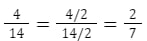
HCF (4, 14) = 2

The ratio in the simplest form,

4: 14 == 2: 7
2nd ratio

6: 21

HCF (6, 21) = 3

The ratio in the simplest form

6: 21 = = 2: 7

Since both ratios in their simplest forms are 2:7, thus the original ratios were equivalent.

Use of Equivalent Ratios

In mathematics and other sciences, equivalent ratios have many applications. Some examples of uses are:

  • To make the ratios provided simpler.
  • We use equivalent ratios to solve any ratio-related problem.
  • To calculate ratios between various fractions.
  • Various direct proportionality-related scientific issues.

There are also a lot more uses like this.

Read: Applications of Percentage

Summary

We learned about the circumstances under which ratios or proportions are equivalent in this article. We discussed a few instances of equivalent ratios. The following ideas we learned were how to find equivalent ratios. We also discovered how ratios are equivalent using these techniques. Last but not least, we solved several cases that illustrated the concept of equivalent ratios.

Frequently Asked Questions

1. What are Ratios? What are the Components of Ratios?

Ans: Ratios are defined as a comparison between two quantities of the same type. A ratio has 3 parts, 2 parts are the numbers representing the compared quantities antecedent and consequent, and the third part is a symbol, specifically the ‘:’ (colon) symbol, that is put between the two to represent the comparison.

2. Why are Equivalent Ratios Important?

Ans: The equivalent ratios can be used to explain certain relationships between objects in daily life. For instance, if two pens cost Rs. 10, we can use equivalent ratios to determine the price of any other number of pens or the number of pens that can be purchased with a given sum of money. Many other real-world issues can be resolved using equivalent ratios.

3.What are Proportions? What is the Symbol of Proportions?

Ans: Proportions are a comparison between two or more ratios. If two ratios are in proportion, then they are also equivalent.
Perimeter of Shapes – Definition, Formulas and Example

Introduction

We see many types of shapes in different objects in our daily lives. Geometry is all around us, so much so that we don’t even notice how many named shapes we see or use for our everyday activities. All such geometrical objects have two measuring quantities, which are Area and Perimeter.

The formula for the area and perimeter of a plane figure can be used to calculate the dimensions of two-dimensional shapes. The perimeter is the distance around the edge of the shape, while the area is the space encircled by any closed figure.

This article focuses on the perimeter and its applications in day-to-day life.

Perimeter

The perimeter of any geometric shape is defined as the sum of the length of all the sides of that figure, or in other words, the total length of the boundary around a geometric shape.

The Perimeter of Commonly Known Shapes.

Usually, the perimeter of a shape can be calculated by simply just adding the length of all the sides of the shape. But some geometric shapes have certain properties that make it easier to calculate the perimeter of that shape using a simple formula, such as any Regular polygon, we know regular polygons have all sides equal, so for any n-sided polygon, we can find the perimeter by simply multiplying the side length by n. Some other geometric shapes whose perimeter can be defined using a formula are given in the table below

S. no.ShapePerimeter Formula
1.Equilateral Triangles (with sides a)3a
2.Isosceles Triangle (with equal sides a and third side b)2a+b
3.Square (with sides a)4a
4.Rhombus (with sides a)4a
5.Rectangle (with length l, and breadth b)2(l+b)
6.Parallelogram (with adjacent sides l and b)2(l+b)
7.Kite (with two adjacent sides, a and b)2(a+b)
8.Regular n-gon (n-sided polygon) with sides an a
9.Circle (with radius r)2πr
10.Semicircle (with radius r)πr+2r=(π+2)r

The Perimeter of a Combination of Shapes.

Unlike the Area, the perimeter does not just simply add up when two or more shapes are combined, rather the perimeter of the combined shape is usually smaller than the sum of its parts depending on the type of combination.

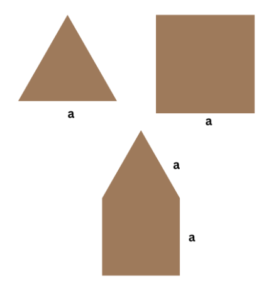
For Example, take this pentagon-looking shape formed using combining a square and an equilateral triangle of the same side length by their sides.

Here, from the previous section, we know that Perimeter of Triangle = 3a Perimeter of Square=4a The perimeter of the Combined Shape=5a<3a+4a=7a

Here, from the previous section, we know that

Perimeter of Triangle = 3a

Perimeter of Square= 4a

The perimeter of the Combined Shape = 5a < 3a + 4a = 7a

Uses of the Perimeter in Real Life

Perimeter does not quite find any major use in real life, except for measuring boundaries of fields or buildings for fencing purposes. A similar kind of use of fencing is during Christmas when we measure the perimeter of rooms in our house to hang Christmas lights along the walls. Perimeter is used to measure the fences around a protected area, it is also used to calculate the cost of putting the fence. As said before, perimeter does not have a variety in its applications. However, the perimeter can be used to calculate the lateral/curved surface area of 3d objects such as Prisms and Cylinders.

Area

The area is defined as the measure of the region enclosed within the boundaries of a shape.

Solved Examples

Example: What is the perimeter of an isosceles trapezium whose parallel sides are 10 m and 12 m, and the non-parallel sides are 5 m?

Solution: The perimeter of a trapezium has no specific formula; thus, we will simply add all the sides to find the perimeter.

Perimeter = Sum of all the sides

Perimeter = 10 + 12 + 5 + 5 = 32m

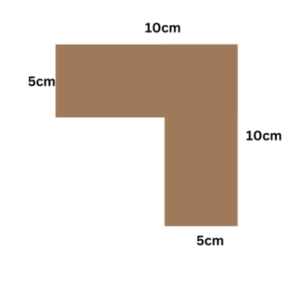
Example: What is the perimeter of the following shape, which can be described as a small square cut out from a large square? How does the perimeter of the larger square change from this change in its shape?

Here, in this image, we can see that the shape is a square of the side of 10 cm, and from it, a smaller square of a side of 5 cm is cut out.

Solution: Here, in this image, we can see that the shape is a square on the side of 10 cm, and from it, a smaller square on a side of 5 cm is cut out.

The length of the sides remaining on the larger square is = 10cm – 5cm = 5cm.

Thus, we can calculate the perimeter now, as all the sides are known.

Perimeter = 10cm + 10cm + 5cm + 5cm + 5cm + 5cm = 40cm.

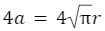
Also, the perimeter of the original large square is 4a = 4 × 10cm = 40cm.

Thus, there is effectively no change in the perimeter of the large square.

Summary

This article discusses the topic of Perimeter, the Perimeter formula for some commonly known shapes, while also shining a light on the uses of the perimeter in daily life. The perimeter of a geometric shape is defined as the length of the boundary of that shape. Perimeter is used to calculate the fencing around objects or places.

Frequently Asked Questions 

1. What do you mean by Perimeter? How will you explain it to someone who has no Mathematical Knowledge?

Ans. Perimeter is defined as the length of the boundary of a geometric shape. To a person who does not know in this regard, we can explain the perimeter as, suppose we take a rope and encircle it tightly along the edges of a shape, then the length of that rope is the perimeter of the shape.

2. What will be the Perimeter of a Square, which has the same area as a Circle with a Radius of r?

Ans. The area is given to be equal, so we will find the length of the side of the square using the areas, and then use that to find the perimeter.

Area of the circle = πr²

Area of a square =

Area of the square = Area of the circle

a² = πr²

The perimeter of the square =

3. What is the use of Perimeter in the Calculation of the Lateral Surface Area of any Prism?

Ans. The lateral surface area of a prism is calculated using the formula

LSA = Perimeter of the base × Height

Thus, the perimeter of the base is used to calculate the lateral surface area of a prism.

4. What are the differences between Perimeter and Area?

PerimeterArea
Perimeter is defined as the measure of the length of the boundary of a geometric shape.The area is defined as the measure of the 2D region entrapped within the boundaries of a geometric shape.
Perimeter is a 1D quantity.The area is a 2D quantity.
Perimeter is measured in the unit of length. Thus, its SI unit is m (metres).The area is measured in the square of the unit of length. Thus, its SI unit is m2 (square metres)


What are Upanishads?

Introduction

The Upanishads were written between 700 and 400 BCE  in the Sanskrit language. They contributed to the ancient people’s advancement in spiritual understanding. Vedanta also known as the Upanishads means “end of the Vedic period”. There are roughly 200 Upanishads, the most famous of which are the Aitareya Upanishad, Brhadaranyaka Upanishad, Chandogya Upanishad, Isha Upanishad, Katha Upanishad, Kausitaki Upanishad, Kena Upanishad, Maitri Upanishad, Mandukya Upanishad, Mundaka Upanishad, Prashna Upanishad, Sveta.

Birth of Upanishads

The Vedas could only be read and translated by Brahmins, regular people had great difficulty understanding them. Saints, therefore, wrote a summarized version of the Vedas that included additional queries and concepts in the form of Upanishads. The Upanishads were written at a time when there was a great deal of social, political, and economic unrest. The rural tribal civilization was in danger of extinction because the monarchy absorbed the people into urban life. In times of uncertainty, learnings from the Upanishads gave people peace, a sense of self-realization, and purpose.

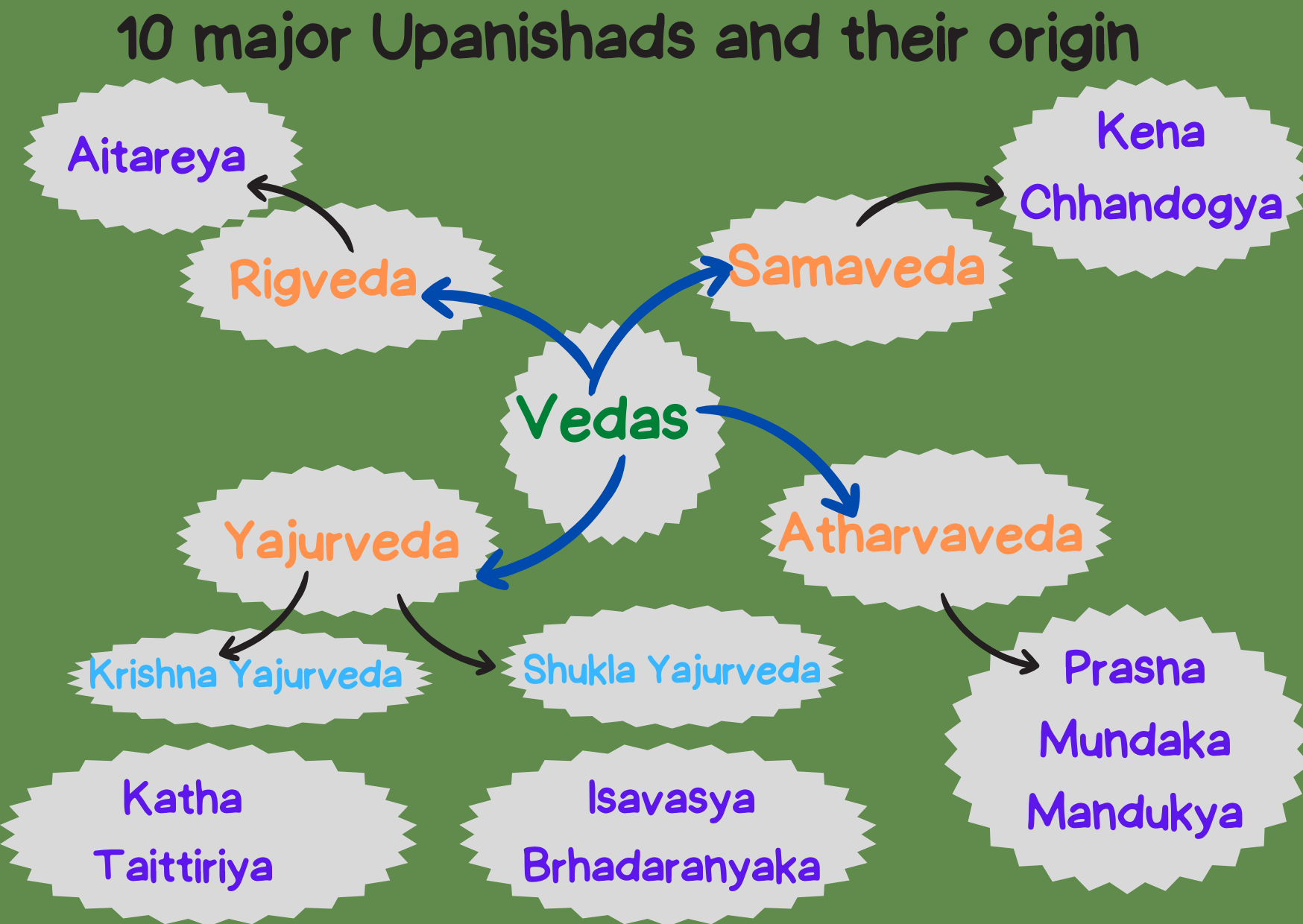
Upanishads originated from Vedas. There are two hundred Upanishads out of which ten are main.

Upanishads and Indian Society

The Upanishads are the repository of Hindu philosophy, and they served to uplift and maintain Hindus for a long period. Combining various Upanishads will give a good picture of the kind of civilization and way of life that existed during that era. 

At that time, the kings were specialists in both administration and warfare. They made an effort to promote knowledge of Vedic religion and also provided sanctuary for wise men and sages. 

The Upanishad era was characterized by a strong caste system. In terms of the Ashram system. Brahmacharya, Garhasthya, and Vanaprastha were more prevalent, while Sannyasa may also have been practised. The sanctity and integrity of each person’s private life were emphasized.

The status of women in Hindu society during that era was relatively high. During this time, females participated in spiritual discussions. Gargi and Maitreyi were famous women who participated in such discussions and gave their views regarding various spiritual topics. 

Learnings from Upanishads

The Upanishads are thought to be the authentic teachings of the sages of ancient India.

Learnings from the Upanishads include:

  • The philosophy of human spiritual realization, including the meaning of life, existence, birth, and death, is addressed in the Upanishads.
  • It explained the complicated truth of existence and how a  person can correct his thinking and be inspired to think differently from the inner soul’s perspective.
  • It enabled people to examine their beliefs and give their relationships more meaning.
  • The Upanishads describe the understanding of Brahman and Atman’s self-existence. Atman is a particular soul, while Brahman is the all-pervading soul.
  • People learned about their being and how Brahman and Atman combined formed the substance of “permanence” (which existed) through the Upanishads.
  • The four doctrines of dharma, karma, samsara and moksha are the foundation of the Upanishads and are well explained in these texts.
  • According to the Upanishads, a spiritually aspirational person must think about the symbolic sacrifices that occur in the mind rather than concentrating on external sacrifices.
  • Last but not least, the Upanishads explain the self-realization theory. By realizing the purpose of life, people might lessen their sorrow and suffering.

Interesting Facts 

  • The best place to learn about self-realization and life’s realities is from the Upanishads.
  • The impact of the Upanishads was not limited to India; it also extended to other nations.
  • Although there are about 200 Upanishads, the majority of Hindu literature only mentions 108 of them.
  • These Upanishads were among the earliest intellectual writings ever discovered; they even predated the Bible and the Qur’an by 800 and 1300 years, respectively.
  • The Upanishads claim that Hindu sages united several Gods because they believed in unity. 
  • Agni, Indra, and other Vedic deities are compared to the highest truth and given a spiritual purpose.
  • The development of various Vedanta that differed from the Brahman and Atman aspects was aided by the Upanishads.

Summary 

The most important learning from the Upanishads-The final triumph, the victory of the soul over matter and man over nature, helped to establish, sustain, and perpetuate a vast heritage of spirituality. This was achieved, through the courageous pursuit of logical conclusions and intuitive, undetectable encounters outside the realm of reason. The experiences received from these learnings merged into a single principle that helped in human development. Upanishads are one of the oldest spiritual texts in Indian history, which helped man to live a life and build a society.

Frequently Asked Questions 

1. What do Dharma, Karma, Samsara, and Moksha Mean?
Ans:  Karma denotes a person’s response to an action. Dharma refers to a person’s obligations and responsibilities to society. Samsara, the cycle of both life and death, arises. Moksha is the ultimate goal of departing from the cycle of rebirth and death.

2. Who is the Upanishads’ Author?
Ans: The Upanishads’ author is still a mystery. The Upanishads are said to have been written by several authors. The scriptures were written with the help of famous sages like Aruni, Balaki, Sanatkumara, Yajnavalkya, and others.

3. Give the four Ashramas of the later Vedic Era.
Ans: The 4 ashrams of the Vedic period are-

  • Brahmacharya: A phase in the Gurukul, the education process.
  • Grihastha-A man was supposed to have a wife and children. Have a family life.
  • Vanaprastha: A stage of life during which a person was supposed to put aside materialistic ambitions and relocate to the forests.
  • Sanyasa: A man who abandons material interests to pursue exclusively spiritual objectives.

4. Give the names of the four Vedas. Which Veda is the Oldest?
Ans: The Rig Veda, Sama Veda, Yajur Veda, and Atharva Veda are the four Vedas of the Vedic era. The oldest of them all is the Rig Veda.

Magadh

Introduction

In Indian history, the rise and expansion of the Magadh empire are famously attributed to the time between 684 and 320 BCE. Avanti, Koshala, Magadha, and Vatsa were competing for supremacy among the sixteen Mahajanapadas from the sixth to the fourth centuries BCE. But the Magadha Kingdom was able to seize power. It rose to become India’s most powerful kingdom. The Magadh empire was Founded by Jarasandha, the son of Brihadratha. The capital of Magadh was located in Rajgir before being moved to Patliputra.

lead magnet

Magadh the Land of Power?

Between the fourth and sixth centuries BCE, Magadh rose to become a strong kingdom. Under the leadership of numerous powerful and effective kings, the kingdom prospered. The following are some of the factors that contributed to the establishment of the kingdom:

  • Magadh was surrounded by three rivers, which served to both protect it from outside threats and facilitate trade and commerce. Additionally, Magadh’s two capitals were in ideal locations.
  • In Magadh, there was a plentiful source of raw minerals including iron and copper, which helped the kingdom prosper.
  • Magadh’s lush terrain benefited the agricultural industry of the time by boosting it.
  • Magadh possessed many soldiers and a large arsenal. Elephants were also employed by the army at that time, greatly enhancing its power.
  • Additionally, the development of Buddhism and Jainism had a significant impact on the development of the thought of the society as well as the expansion of the empire.

History of Magadh – Ancient India

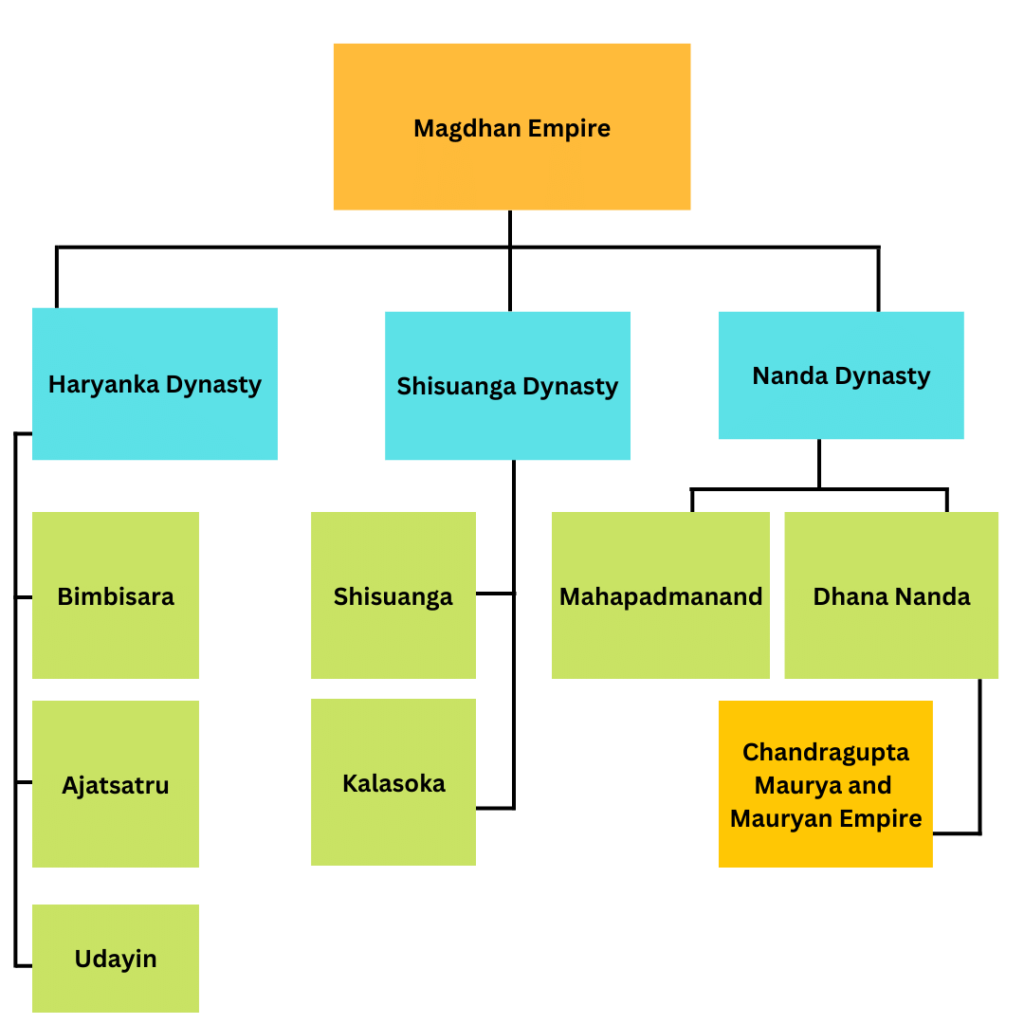
Three significant dynasties ruled the Magadh empire: the Haryankas, Shisunaga, and Nanda dynasties. The empire’s greatness reached a very high peak thanks to a few outstanding kings from those dynasties.

Want to get an “A” on your Social Studies exams? Let our expert teachers be your guide toward improving your grades and reaching your highest potential. Study Social Studies tuition for classes 6th, 7th, and 8th.

Haryanka dynasty

The first dynasty of the Magadh kingdom was the Haryanka dynasty. The well-known kings of this dynasty were Bimbisara, Ajatashatru, and Udayin.

  • King Bimbisara ruled From 544 to 494 BC. He was the first monarch to establish matrimonial alliances as a way to strengthen the kingdom. He followed both Jainism and Buddhism.
  • Ajatshatru, Bimbisara’s son, was accused of murdering his father. From roughly 494 to 462 BC, Ajatshatru presided over Haryanka’s dynasty. He used aggressive tactics to expand his kingdom.
  • The following king, Udayin who was Ajatshatru’s son, led the realm. He was instrumental in moving Magadh’s capital from Rajgir to Patliputra. Nagadasak was the last ruler of the Haryanka dynasty.
lead magnet

Shisunaga’s Dynasty

This kingdom’s existence was reported between 413 and 345 BCE. Shisunaga and Kalasoka were the two prominent kings of the Shisunaga dynasty.

  • Shisunaga was chosen by the public to lead the Magadh kingdom after Udayin’s reign. Shisunaga eventually put an end to the almost 100-year battle between Magadh and Avanti and was successful in incorporating the Avanti kingdom into the Magadh empire.
  • King Kalasoka, the son of  Shisunaga, was another significant ruler of the Shishunaga dynasty. He gained national attention for presiding over the second Buddhist council at Vaishali.

Nanda’s Dynasty

The two most effective and greatest kings of the Nanada dynasty were Mahapadma Nanda and King Dhana Nanda. This dynasty’s existence was documented between 345 and 321 BCE. It was the Magadh Empire’s final dynasty. The unique future of this dynasty was that the kings were not Kshatriyas.

  • Mahapadma Nanda founded the Nanda dynasty. After killing king Kalasoka, he ruled the kingdom for twenty-eight years. Mahapadma Nanda’s dynasty brought prosperity and success to Magadh, which boasted a high number of soldiers and a flourishing economy.
  • Dhana Nanda headed the Nanda dynasty after the rule of Mhapadma Nanda. In this kingdom, he was the last powerful king. Alexander attacked India during the reign of Dhana Nanda. In the end, Chandragupta Maurya defeated Dhana Nanda and gained control of the empire.
magadha empire family tree

                                           Fig: Flowchart of Magadh Empire

Establishment of the Mauryan Empire

The well-known Mauryan dynasty ruled from 324 to 184 BCE. The famous emperors of the Mauryan dynasty were Chandragupta Maurya, Bindusara, and Ashoka.

  • After removing the last Nanda king, Dhanananda, from power, Chandragupta Maurya established this empire. From roughly 321 to 297 BC, Chandragupta was in power. He was a prosperous ruler in his kingdom.
  • The son of Chandragupta Maurya, Bindusara, greatly expanded the kingdom’s prosperity. From roughly 297 to 273 BC, he was in charge of the kingdom. Mysore was thought to be part of the Maurya empire as well.
  • The renowned historical ruler Ashoka Vardhana ruled after Bindusara. He introduced Buddhism to the populace of the nation. For approximately 40 years, he governed the kingdom. The first king in history to have his rules engraved on rocks was Ashoka. He was also among the most powerful monarchs who significantly increased the fame of the Maurya dynasty.
  • Later, Shungas, Palas, Satvahanas, Guptas, etc. ruled over Magadh. The development of Magadh’s history was significantly influenced by these powerful dynasties.
lead magnet

Summary

Between the fourth and sixth centuries BCE, Magadh rose to become a strong kingdom. In Magadh, there was a plentiful source of raw minerals, including iron and copper, which helped the kingdom prosper. Three significant dynasties ruled the Magadh empire: the Haryanka, Shisunaga, and Nanda dynasties. The well-known Mauryan dynasty ruled from 324 to 184 BCE. Later, the Shungas, Palas, Satvahanas, Guptas, etc. ruled over Magadh. The development of Magadh’s history was significantly influenced by these powerful dynasties.

Frequently Asked Questions 

1. Why did the Magadha Empire choose Pataliputra as its capital? Which was the capital of Magadha Earlier?
Ans: Pataliputra was the best place to serve as the imperial capital because it was in the heart of Magadha. The capital of Magadh was located in Rajgir before being moved to Patliputra.

2. What was the name of Magadha’s first King? In which time Period he Ruled?
Ans. King Bimbasara was the first king of the Magadha empire. King Bimbisara ruled from 544 to 494 BC. He was the first monarch to establish matrimonial alliances as a way to strengthen the kingdom. He followed both Jainism and Buddhism.

3. What was the reason for the fall of Magadha?
Ans. The rise of Jainism and Buddhism, a financial crisis, oppression by the Dushtamatyas, internal conflicts, and division of the empire into multiple provinces led to the fall of Magadha.

4. Which ruler ruled the Magadha Empire for the Last Time?
Ans. A new king, Mahapadma Nanda, took over as king of this Nanda dynasty in the middle of the fourth century BCE after the last ruler of this dynasty was murdered. This was the last dynasty in Magadha until the Mauryans overtook it.

Particles of Matter Have Space Between Them

Introduction

The matter may be found on Earth in three different states: solid, liquid, or gaseous. Every matter is composed of incredibly tiny building components called atoms and molecules. These particles in a solid are strongly attracted to each other and vibrate in place without passing by each other. Despite not being as strong as it is in a solid, there is still an attraction between the particles in a liquid. The proximity and frequent movement of the particles in a liquid allow them to slip past one another. There is only a weak attraction between gaseous particles. They are continually moving and spread out compared to the particles in a solid or liquid. Here the particles do not interact when they collide; they just strike and bounce off of one another. This article provides a thorough understanding of the concept of matter of space between particles and attraction between the matter particles with specific instances.

Particles have Space between Them

Let’s observe a small activity to determine whether the particles are separated from one another; this is explained below.

Experiment

Take a beaker filled with 100 ml of water and then add 20 gm of sodium chloride (table salt) into it. Make sure to swirl the water with a glass stirring rod until all the salt has completely dissolved. The salt will dissolve, and then we will get a solution.

Observations

It has been observed that even after 20 gm of salt has been dissolved in 100 ml of water, the level of the water doesn’t actually rise. This displays how free and interparticle space-containing water atoms are. This area is known as the interparticle or intermolecular space. In this interparticle area, the salt granules that were scattered have settled.

Particles of Matter are Constantly Moving at Random

Diffusion and Brownian motion demonstrate that particles are moving.

Diffusion

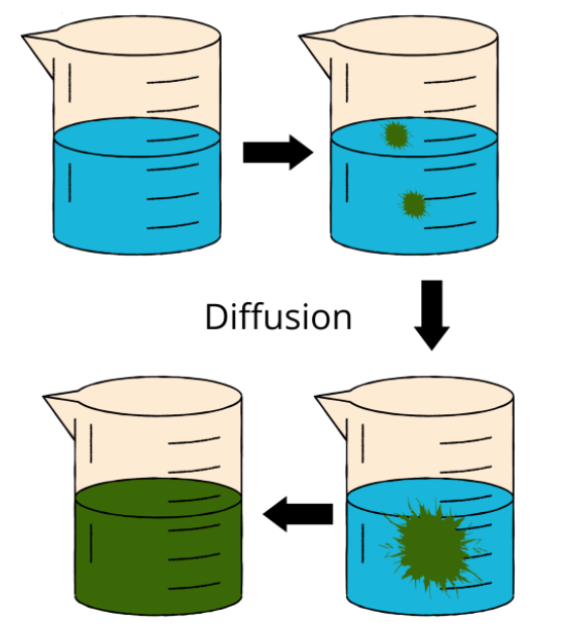
A material will mix and disperse with another substance through a process called diffusion while its particles are in motion. To homogenize the mixture, this process is repeated. For instance, the ink diffuses in the water as a result of the random movement of water and ink particles. Ink migrates from areas of higher concentration to regions of lower concentration at a pace that is inversely associated with the liquid diffusion rate of the ink. Diffusion occurs in liquids, solids, and gases, however, it occurs more rapidly in gases and less efficiently in solids.

Brownian Motion

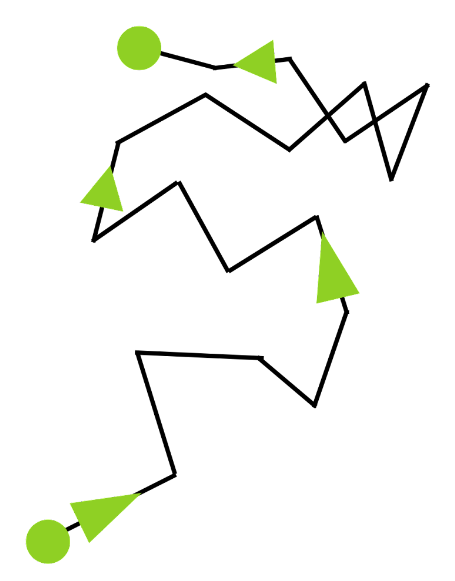
Brownian suspended several pollen grains in water and then examined them under a microscope. He saw that the pollen grains were moving in a zigzag pattern. The movement is significantly more evident when the water is warmed. Water is made up of randomly migrating atoms. As a result, the moving atoms frequently strike the pollen grains, causing them to migrate. As an example of Brownian motion, the pollen grains are travelling in this manner.

Particles of Matter Attract Each Other

A force acting on the particles of matter holds them together. Some substances crumble into powder, while others form tiny crystals, and still, others are challenging to separate. The strength of the force of attraction varies from one type of substance to another, depending on that substance. This is done so that the force of attraction between the particles can keep the particles inside them. This interparticle force of attraction exists in all substances that cause the attraction of particles. Therefore, to break objects, we must defeat the force of attraction. A varying amount of strength is necessary depending on the chemical.

Particles of Matter Attract Each Other

Examples show that breaking a chalk is easier than breaking a nail. This illustrates how 

various material particles have varied levels of attraction. The attraction between particles of the same material is referred to as “cohesion.”

Summary

The particles are separated by a certain amount of space, in which the gaseous form of matter has the largest inter-particle space among the three states of matter. Interestingly, the interparticle gaps that exist in various types of matter are what give rise to the three states of matter, and therefore the density of different states of matter increases from a gas to a solid state (for example water vapor to water and then ice). 

Frequently Asked Questions

1. Define Matter.

Ans: A component that is made up of several types of particles, takes up space, and has motion is referred to as “matter.”

2. What Constitutes Matter?

Ans: Matter is made up of atoms, which are made up of electrons, protons, and neutrons.

3. How to Develop the Model of Particles of Gas and Liquid?

Ans: By compressing a flexible plastic container with a balloon on top, we can imitate the gas particles. We can also try to squeeze a water-filled container as part of their modelling of liquid particles.

Criteria for Congruence of Triangles

Introduction

If all three angles and three sides of one triangle are the same size and dimension as the corresponding angles and sides of the other triangle, then the two triangles are said to be congruent.

The size and shape of any two congruent triangles are the same. Angles in one triangle have a measure that is the same as angles in another triangle. The corresponding sides of the congruent triangles also have equal lengths. Triangles that are congruent with one another can reflect or rotate another.

Congruent Meaning

If two figures can be placed exactly over one another, they are said to be “congruent.”

Take bread example as an example. The bread slices are stacked one on top of the other so that the top slice completely encloses the bottom slice. When stacked on top of the other, every slice of bread is the same size and shape. When something is congruent, it must have the same size and shape. Mathematics uses the term “congruence” to describe when two figures have similar sizes and shapes.

Congruence of Triangles

A triangle is a closed 3-sided figure in geometry. A triangle is a closed polygon made up of three lines that intersect at three different angles. The two triangles are said to be congruent if all three corresponding sides are equal and all three corresponding angles have the same measure. The appearance of these triangles remains constant when they are moved, rotated, flipped, or turned. If the triangles are moved, they must be superimposed to be congruent. As a result, if the triangles’ corresponding sides and angles are equal, the triangles are congruent. Thus, along the corresponding sides and angles, the congruent triangles can be stacked one on top of the other.

Online Coaching Maths Tuition Classes 7 Are The Best Way To Go

Congruence Criteria for Triangles

Five triangle congruence rules can be used to determine whether a given pair of triangles are congruent or not. The six dimensions allow for a perfect definition of any triangle. The particular triangle has three sides, as well as three angles. As a result, only three of the triangles’ six parts can be used to determine whether two triangles are congruent. The acronym CPCT stands for “Corresponding parts of Congruent triangles”. Triangles can be shown to be congruent, at which point the remaining dimension can be predicted without having to calculate the triangles’ missing sides and angles. The following lists the five triangle congruence rules.

  • SSS (Side-Side-Side)
  • SAS (Side-Angle-Side)
  • ASA (Angle-Side-Angle)
  • AAS (Angle-Angle-Side)
  • RHS (Right angle -Hypotenuse-Side)

Note: ASA and AAS are not the same. Like ASA and AAS, SAS does not have any related counterpart like SSA, However, a variation of ASS exists for right triangles as RHS, where R is the angle and the other two, i.e., H and S, are sides.

Congruent Triangles Properties – CPCT

Congruent triangles have all their sides and angle equal, thus if two triangles are where we know all the properties of one and not the other, then we can find all the properties of the second triangle by simply comparing the corresponding parts in the first. Congruent triangles are most frequently referred to using the abbreviation CPCT. The term “Corresponding Parts of Congruent Triangles” is abbreviated as CPCT. It is a crucial characteristic of congruent triangles. Congruent triangles’ respective parts are always equal. The congruent triangle properties refer to this.

Types of Congruence

There are 5 types of triangle congruence criteria.

Side Side Side (SSS)

Side Side Side or also known as SSS congruence criteria states that if all three sides of two triangles are equal, then the triangles are congruent.

Side Side Side or also known as SSS congruence criteria states that if all three sides of two triangles are equal, then the triangles are congruent.

Side Angle Side (SAS)

Side Angle Side or also known as SAS congruence criteria states that if two sides and their included angles are equal in two triangles, then the triangles are congruent.

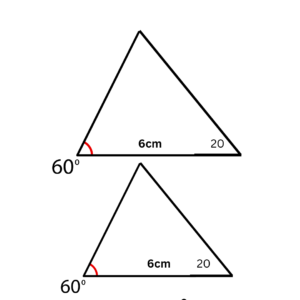
Angle Side Angle or also known as ASA congruence criteria states that if a side and two angles on it are equal in two triangles, then the triangles are congruent.

Angle Side Angle (ASA)

Angle Side Angle or also known as ASA congruence criteria states that if a side and two angles on it are equal in two triangles, then the triangles are congruent.

Angle Angle Side or also known as AAS congruence criteria states that if two angles and a side not common to the two angles are equal in two triangles, then the triangles are congruent.

Angle Angle Side (AAS)

Angle Angle Side or also known as AAS congruence criteria states that if two angles and a side not common to the two angles are equal in two triangles, then the triangles are congruent.

Right angle Hypotenuse Side or RHS congruence criteria only applies to right triangles, it says that in two triangles if they have a right angle, and their hypotenuses and one other side are equal in both triangles, then the triangles are congruent.

Right angle Hypotenuse Side (RHS)

Right angle Hypotenuse Side or RHS congruence criteria only applies to right triangles, it says that in two triangles if they have a right angle, and their hypotenuses and one other side are equal in both triangles, then the triangles are congruent.

 If two figures share the same shape and size, they are said to be congruent; alternatively, if a figure shares the same shape and size as its mirror image, it is said to be congruent to its mirror image.

Summary

In this article, the topic of congruence is discussed in detail. If two figures share the same shape and size, they are said to be congruent; alternatively, if a figure shares the same shape and size as its mirror image, it is said to be congruent to its mirror image.

This article also shines a light on the topic of Rules of congruence for triangles. There are 5 basic congruence criteria, namely SSS, SAS, ASA, AAS, and RHS.

For more help, you can Refer to Lesson 23 congruence of Triangles in Math Class 7.

Frequently Asked Questions

1. What do you mean by Congruence?

Ans 1. Congruent figures are geometric objects that share the same size and shape in mathematics. The two figures are equal and are referred to as congruent figures.

2. Are all Squares Congruent?

Ans 2. No, all squares are not congruent, since for congruence two figures must have all of their quantifying dimensions must be equal, that includes all the sides and all the angles. All squares have the same angles, but their side lengths are different, hence they aren’t congruent.

3. Is AAA a criterion for the Congruence of Triangles?

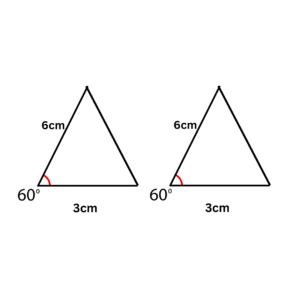
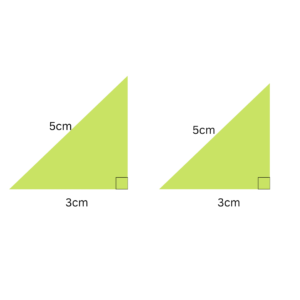
Ans 3. No, AAA is not a criterion for congruence because even if all the angles of two triangles are equal, that necessarily does not mean that they have the same side length, for example two equilateral triangles of sides 3cm and 5cm, both have the same 60-60-60 angle, but they are not congruent because their sides are of different lengths.

Light Travels Along a Straight Line

Introduction

One type of energy that is essential to our existence is light. We are unable to envision a world without light. Light improves the beauty of everything around us and allows us to see. In both science and art, light is a crucial element. One of the crucial scientific instruments that enable scientists to examine things all across the world is light.

Some scientific theories claim that it is made up of particles, while others assert that it is made up of waves. What is the medium of propagation if the light is a wave? How does light move? We shall find answers to some of these questions in this article.

How does Light Travel?

Light can pass through a medium and in a vacuum. However, there won’t be any particles in a vacuum that light can’t reflect off of. Therefore, light is invisible in a vacuum. Light can reflect in the air when it strikes dust or other particles, making light visible in the atmosphere. Light may be thought of as having waves. Different light waves have varied wavelengths, and different light has different colours based on the wavelength. For instance, the shortest wavelength of light has a violet colour, whereas the highest wavelength of visible light has a red colour. Light, being a wave, may exhibit wave characteristics like diffraction and interference.

lead magnet

The answer to the question of how light typically moves is that it moves straightforwardly. However, the truth is that light’s smaller diffraction effect is the reason it appears to move in a straight line. The spreading out and the illumination of an area where a shadow is anticipated is known as diffraction, which is the bending of waves around an object. The wavelength of light is on the order of nanometers. We cannot see impediments of this size with our unaided eyes because the wavelength is too narrow. As a result, we see that light moves in a straight path. Rectilinear propagation of light is another name for the way that light moves in a straight line.

Want to get an “A” on your Science exams? Let our expert teachers be your guide toward improving your grades and reaching your highest potential. Study Science tuition for classes 6th, 7th, and 8th.

Experiment with the Straight Line Motion of Light

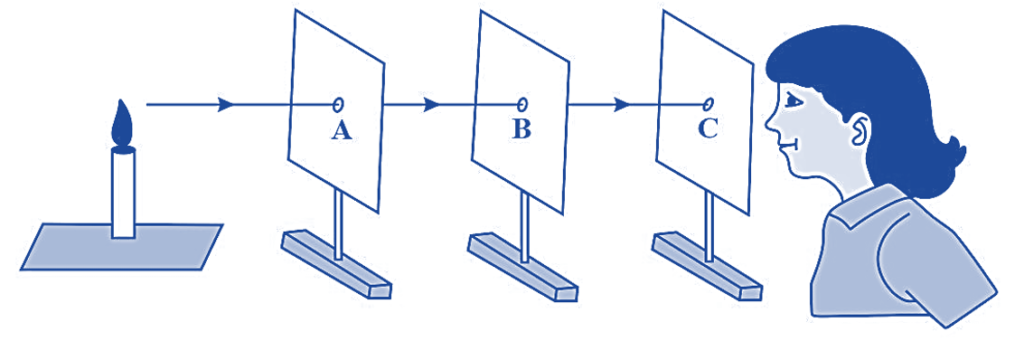
Normal light travels in a straight line because there isn’t enough diffraction to cause any noticeable effects. We demonstrate that light moves in a straight line using a basic experimental setup. In front of a candle on the tabletop, arrange three cardboard sheets back to back. Ensure that the candles and cardboard sheets are arranged in a straight line. On each cardboard sheet, poke a pinhole after lighting the candle. To allow for the visibility of the candle’s flame, the holes must be made at equal heights. Now, observe which line light travels in by looking through the holes. Along the slender line of holes, the thin flame will be visible. Now move one of the cardboard sheets to either side and observe the flame. Can you see the flame? The flame won’t be seen when you move the cardboard sheet. Reposition the cardboard sheet in its original location. The flame may now be seen. The experiment diagram is shown below. From this experiment, we may infer that light moves in a straight line.

Straight Line Motion of Light Experiment

Examples of Straight-Line Motion of Light

  • When a lamp, torch, or another source of light emits light, it travels in a straight line.
  • When sunlight enters a dusty environment through tiny holes, a straight-line trail of light is apparent.
  • The object will become invisible when an opaque object is placed in front of it. The reason for this is that an opaque object prevents light from bending through its corners.

Summary

The light rays move in a straight line. The minimized diffraction effects of light facilitate the propagation of the light in a straight path. Examples, where the light rays travel in a straight line, are the light ray that comes from a train, a torch, and/or a lamp.

lead magnet


Frequently Asked Questions

1. What is Rectilinear Propagation of Light?

Ans: The motion of the light rays in a straight line is termed the rectilinear propagation of the light.

2. Explain why Light Travels in a Straight Line?

Ans: Diffraction is a wave characteristic of light. Only when the wavelength of the light wave is of the order of the dimension of the size of the particle it collides with, and the phenomena of diffraction take place. The wavelengths of light are on the order of nanometers. Typically, a nanometer-sized item is invisible to the human eye. Light’s diffraction impact is therefore too modest to be taken into account and travels in a straight-line path.

3. Why is Light Invisible in a Vacuum?

Ans: Light can travel through the vacuum, however, since there are no particles available in the vacuum, light cannot reflect in a vacuum and therefore light is invisible in a vacuum.

Effect of Change of Pressure

Introduction

Pressure can be defined as the force exerted perpendicularly per square unit of area of any object. It is represented by the formula,                                                                                                                        

                                                             P = F ⁄ A

where P is the pressure, F is the force exerted on the object, and A is the area of the object. Pressure is measured in pascal, and is classified into absolute, atmospheric, differential, and gauge pressure. A change in pressure has different effects on different states of matter.

Change in Pressure

Since the pressure exerted on an object is the amount of force applied per unit area of that object, a change in area or a change in the amount of exerted force can result in a change in pressure. For example, if the surface area decreases, the pressure increases simultaneously when the surface area decreases, the pressure decreases provided that the force applied remains constant. 

Effect of Pressure on the States of Matter

Pressure change can have different effects on different states of matter. By exerting pressure on the matter particles, we can draw them closer. Therefore, applying pressure can cause liquids to turn into solids, and when pressure is applied to a gas that is contained in a cylinder, the gas begins to compress and turn into a liquid. As pressure rises, the volume of the gas reduces, which causes the gas to change into a liquid and then finally a solid. The volume of a gas is inversely related to its pressure and directly relates to the number of molecules it contains.

Pressure has less of an impact on solids because they are non-compressible forms of matter. By applying pressure and lowering the temperature, liquids can be transformed into solids.

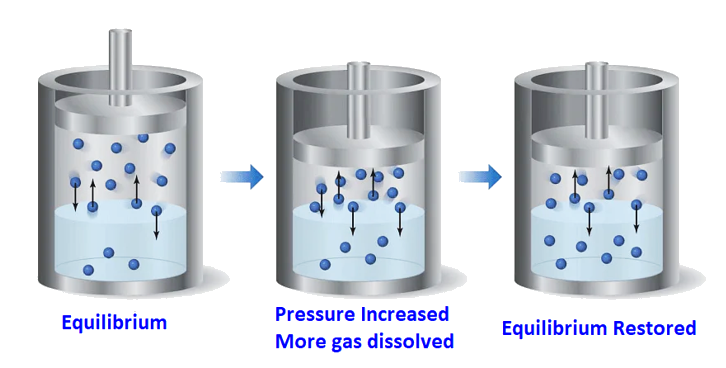
Effect of Change of Pressure

Effect of Pressure on Equilibrium

The equilibrium will adjust to minimize a change in the pressure of a gaseous reaction mixture. If the pressure is raised, the equilibrium will change to favour a fall in the pressure. The equilibrium will change if the pressure is reduced to favour an increase.

When a system’s volume is reduced, the pressure will rise (and the temperature is constant). A greater number of collisions occur with the container’s walls. There will be fewer collisions and hence less pressure if there are fewer gas molecules. The equilibrium will change in a way that reduces the number of gas molecules, which will likewise reduce the pressure. To forecast which way equilibrium will shift in response to a change in pressure, we must consider how many gas molecules are involved in the balanced reactions.

For example, the chemical reaction between nitrogen and hydrogen is shown below:

                                                           N2 (g) + 3H2 (g)→ 2NH3↑

The proportion in the equation that balances is 1:3:2. In other words, the 1N2 molecule combines with the 3H2 molecule to produce NH3 gas (from the balanced equation). Four molecules of reactant gas must therefore be present to produce two molecules of product gas.

  • Pressure buildup will favour the reaction which results in fewer gas molecules. Because there are fewer product gas’ molecules, the forward reaction is more advantageous. Due to the rightward shift in equilibrium, the yield of NH3 will rise.
  • The reaction that produces more gas molecules will be more favourable as pressure drops. If there are more reactant gas molecules present, the reverse reaction is more favourable. As a result of the equilibrium shifting to the left, the yield of NH3 will decline.

Some Facts

  • Pressure is directly proportional to the temperature.
  • In contrast to solids and liquids, gases are more easily subjected to pressure.
  • Compared to gases, solids and liquids are less sensitive to pressure.
  • When air pressure is raised, the boiling point of water rises.
  • The equilibrium will adjust to minimize the change in pressure of the gaseous mixture.

Frequently Asked Questions

1. Does Changing the Size of the Container Affect the Pressure?

Ans: No change in concentration could change the pressure if the equilibrium reaction does not involve a change in the number of molecules in the gas phase. Therefore, altering the container’s size without also altering the pressure would have no impact on the reaction. The number of molecules stays constant and applies the same pressure whether the container size decreases or grows.

2. How can the Physical Condition of the Matter be Altered?

Ans: It is also possible to change the physical state of matter by adjusting the pressure that is applied. For example, by applying pressure and lowering the temperature, gases can liquefy. 

3. How does Pressure Affect the Boiling Point of a Liquid?

Ans: All liquids evaporate with an expansion. The expansion and delay of vaporization are the results of pressure on the surface. As a result, when pressure is applied, the boiling point rises.

Vedic Life in India

Introduction

During the period between 1500 BCE and 800 BCE, society underwent a number of notable changes and the world saw the rise of the Vedic culture. This time period is termed the Vedic age. Hinduism’s holy writings, the Vedas, were written during this time and are now the primary literary sources that provide an understanding of Vedic life.

Indo-Aryan Migration to Vedic Civilization

The arrival of Indo-Aryans on the Indian subcontinent marks the beginning of the Vedic era. These people are thought to have split off from the Indo-Iranian tribes and begun settling in the northern Indus Valley after the great Indus Valley civilization had collapsed. Some historians and archaeologists, however, contend that the Indo-Aryans were native to the Indian subcontinent and that the myth of their migratory origins is untrue. There is disagreement among many schools of thought regarding the Indo-Aryan people’s origin. Some claim that they are from Central Asia, while others suggest that they are from the Russian steppes.

Vedic Civilization 

The Vedic civilization was the second great civilization after the Indus valley civilization that inhabited the Indian subcontinent. This civilization grew and dominated the area of northwestern India during the time period between 1500 BCE to 800 BCE. The people of Vedic Civilization were called Aryans which means noble. These people were pastoral nomads. Cattle rearing was their main occupation during the early Vedic period and in the later Vedic period, agriculture became their main occupation. Apart from cattle rearing, the Vedic people carried out small-scale cultivation to supplement their food needs and also involved themselves in other economic activities like chariot-making, weaving, carpentry, tanning, etc. 

Life of people During the Vedic Period

The Vedic age is basically divided into two phases: The early Vedic Age and the Later Vedic Age. The significant changes in people’s social and cultural life during this time period led to such distinction.

Life of people during the Early Vedic period

Society

The Early Vedic era was characterized by patriarchal culture. The family served as the social unit, and the oldest male member served as the family head. The majority of the populace practiced monogamy, but the leaders occasionally practiced polygamy. Families related by blood formed the clan and clans together formed the Jana or tribe.

There was no caste system in early Vedic society since everyone was treated equally. Based on the people’s occupations, the population was classified into three groups. A person may pick any occupation, regardless of what his ancestors did for a living, and caste was then decided by occupation rather than birth.

Occupation

The Rigvedic age is another name for the early Vedic period. There are numerous indications throughout Rigveda that raising cattle was the Rigvedic people’s primary source of income.  The majority of people at this time were pastoralists. For milk and hides, they raised cattle, sheep, goats, and other animals.

Religion

The Vedic people revered the natural elements. The gods of the Vedic era were incarnations of natural elements. There were various gods who controlled the various needs of the civilization. For instance, warriors worshipped Indra, who was also considered a deity of the weather.

Life of people during the Later Vedic Period

Society and the Caste System

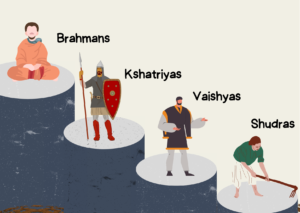
The caste system began to take hold during the later Vedic period when societal divisions changed. The four varnas Brahmans, Kshatriyas, Vaishyas, and Shudras made up the society.

The caste system in the Vedic Age

The Shudras were considered to be untouchables and were subject to slavery. The highest caste, the Brahmans, had access to perform Vedic rites. The caste system was made hereditary, preventing people from choosing the careers they wanted. In the later Vedic period, women’s status decreased and a number of limitations were placed on them. Despite the introduction of the combined family and Gotra concepts, the family nevertheless served as the foundation of society. Since members of the same gotra were blood relatives, marriages within the same gotra were not common.

In the later Vedic period, individuals began organizing themselves to establish towns, and urbanization became apparent. The kingship was inherited, hence the son of a monarch succeeded his father as ruler. The King’s power and authority were increased by an elaborate coronation ritual performed for him by the Brahmans, who were now regarded as the god’s representatives. Northern India witnessed the rise of the 16th Mahajanpadas during this time.

Occupation

Most of the later Vedic people were farmers, and at this time, farming was the people’s main source of income. 

Summary

The 1500–800 BCE era is referred to as the Vedic age. The Aryans were the inhabitants of the Vedic civilization. The early Vedic age and the later Vedic age are the two periods that comprise the Vedic age. 

Early Vedic civilization did not adhere to the caste system and valued individual equality. The society was patriarchal, yet women were respected, had freedom, and were permitted to attend social gatherings.

The caste system was prevalent during the later Vedic period and became hereditary. While the king was regarded as the divine representative, the Brahmans rose to prominence. Women’s status has greatly deteriorated. Shudras were considered untouchables and lived miserable lives.

Frequently Asked Questions

1. Which texts in Vedic literature contain the Gayatri Mantra?
Ans: The Gayatri Mantra, which was written for Savitri, the sun goddess, is found in the third Mandal of the Rigveda.

2. What are the four Vedas?
Ans: Rigveda, Samveda, Yajurveda, and Atharvaveda are the four Vedas.

3. Comment on the origin of Aryans.
Ans: The central Asian regions are said to be the origin of the Aryans. They are thought to have split off from the Indo-Iranian tribes and relocated to live in the Indus Valley’s northern parts.