Blog

No Men Are Foreign

Introduction

No Men are Foreign is a poem by “English Poet,” “James Harold Kirkup,” with a strong viewpoint. The poet wants to convince people that all people are the same and share a common home- the Earth. People shouldn’t be discriminated against because they all breathe the same air, receive the same amount of sunlight, and go through the same processes of birth and death. No Men are Foreign is the poem’s main concept, which is reflected in the title. The poet’s conviction that “all men are the same” is emphasized in the title.

lead magnet
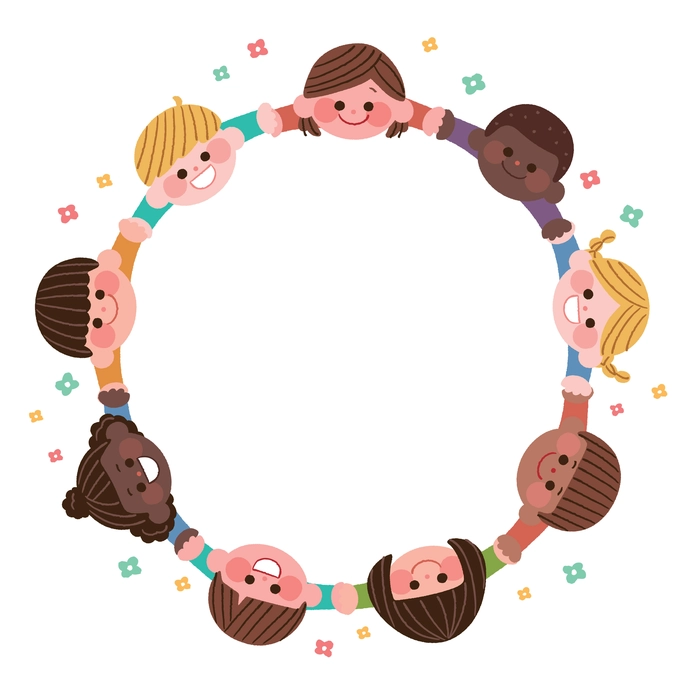
This image shows that all men on earth are equal.

No Men Are Foreign Poem Summary

“Remember no men are strange, no countries foreign”, is the opening and closing phrase of the poem- “No Men are Foreign.” The poet wants to emphasize how similar all living things in this world are despite the differences we have created through building walls, and fences, usage of foreign languages, etc. He longs for humanity to come together despite all the arbitrary divisions between people. Any time there is a war or a winter, everyone suffers. God gave us a happy life, but it is human nature that causes our miseries and brings sorrow.

The poet continues further by stating that our physical and mental features are all the same. He does a wonderful job of illustrating how humans are not inherently different from one another. He tells the reader that when we hate someone, we lie and hate ourselves too. In addition, when we use weapons against someone, we pollute the Earth by leaving behind huge piles of decomposing carcasses, which make the earth filthy. The poem conveys the idea that everyone is born with red blood, regardless of wealth or race. We are all children of mother nature.

For more details watch the video of the English Tuition.

lead magnet

Theme of the Poem No Men Are Foreign

The central idea of no men are foreign revolves around the brotherhood of all humankind. The poet emphasizes that our divisions and distinctions are constructed by humans. James Kirkup portrays the shared qualities of humanity throughout the poem and implores individuals to relinquish their arms and extend an inclusive embrace, fostering a world of harmony and affection without animosity or prejudice.

Conclusion

The poet compared the physical similarity between people who live in different parts of the world to show that all people are created equal. He wants to instill the value of fraternity in everyone. The author of this poem wants to show us how people are similar to one another, how they have similar lives, and how they eventually die in similar ways. No matter your caste or creed, nature offers its best to everyone equally.

lead magnet

TextBook Questions

1. Beneath all uniforms…” What uniforms do you think the poet is speaking about?

Ans: The poet talks about the various clothes that people in other countries wear, and how, underlying them all, the human body is the same.

2. In stanza 1, find five ways in which we all are alike. Pick out the words.

Ans: The 5 words that depict  all men are same are:

  1. “We walk”
  2. “We breathe”
  3. “We have eyes”
  4. “We work with our hands”

3. How many common features can you find in stanza 2? Pick out the words.

Ans: The stanzas list some common traits such as  “Sun, Air, Water, hands and Peaceful harvests necessary for human sustenance.

4.“… whenever we are told to hate our brothers….” When do you think this happens? Why? Who ‘tells’ us? Should we do as we are told at such times? What does the poet say?

Ans: Egocentric people occasionally persuade innocent people to injure others in order to benefit themselves. The common man instructs them to instigate riots because he is irritated by his own fellow beings’ manipulations and cannot understand them properly. The poet cautions against the following advice without giving it careful consideration. A common claim made by the poet is that there is no difference between men and strangers and that everyone on Earth is the same.

5. How does the poet suggest that all people on earth are the same?

Ans: Nobody is unusual or unique, the poet asserts. No country is foreign. Every uniform has a body breathing below it. The land is uniform throughout as well.

No Men Are Foreign Extra Question

1. Is no men are foreign a war poem?

Ans: No men are foreign is a poem that opposes war because it explains why it is unacceptable to treat people differently based on their caste, creed, race, or religion. Everyone shares a brotherhood and is on an equal footing. The message of this poem is that killing others is useless.

2. What is the poet hoping we never forget?

Ans: “Remember, no men are foreign, and no countries strange.” This line appears often in the poem. The poet wants us to remember that no men in this world are different, thus the poet emphasizes the notion of global fraternity

3. Does the poem No Men Are Foreign have a rhyme scheme?

Ans: The entire poem is composed in free verse. The poem lacks a Rhyme scheme.

4. what are the poetic devices in no men foreign class 9

The poem “No Men are Foreign” by James Kirkup uses several poetic devices, including repetition, metaphor, alliteration, personification, and imagery. The repetition of the phrase “No men are foreign” emphasizes the theme of unity and equality among all people.

If you require assistance with English lessons, feel free to join our 9th class English tuitions. In these classes, students will explore a diverse range of topics such as Literary Comprehension, Informal Letter Writing, Diary Entry Writing, and Dialogue Writing.
Bohr’s Atomic Model Postulates

Introduction

In 1913, Neil Bohr introduced the Atomic Model, which was based on Planck’s quantum theory of radiation. In overcoming the limitations of Rutherford’s atomic model and describing the hydrogen spectral lines. One such model appeared to be very effective in describing the atom’s stability, as well as the line spectra of an H atom. This model hypothesis correctly predicted smaller atoms such as hydrogen, but when larger atoms were observed, poor phantom assertions were made. However, it does not describe the Zeeman effect, atomic spectra, the Stark effect, or Heisenberg’s Uncertainty Principle.

An Overview of the Bohr Atomic Model

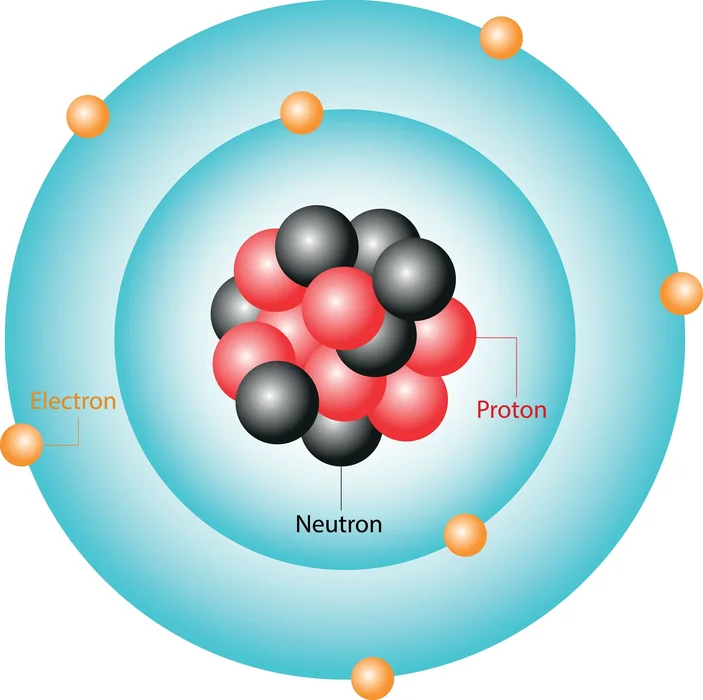
According to Bohr’s Atomic Model, an atom is made up of a tiny, positively charged nucleus surrounded by electrons that move in circular orbits all over the nucleus, attracted by electrostatic forces. He was also awarded the Nobel Prize in Physics for his contributions to atomic structure.

Bohr Atomic Model of a Nitrogen Atom.

The Bohr Atomic Model’s Postulates

1. Orbits are allowable circular trajectories in that electrons travel all over the nucleus.

2. Because each orbit was associated with a specific amount of energy, they were referred to as energy levels and energy states.

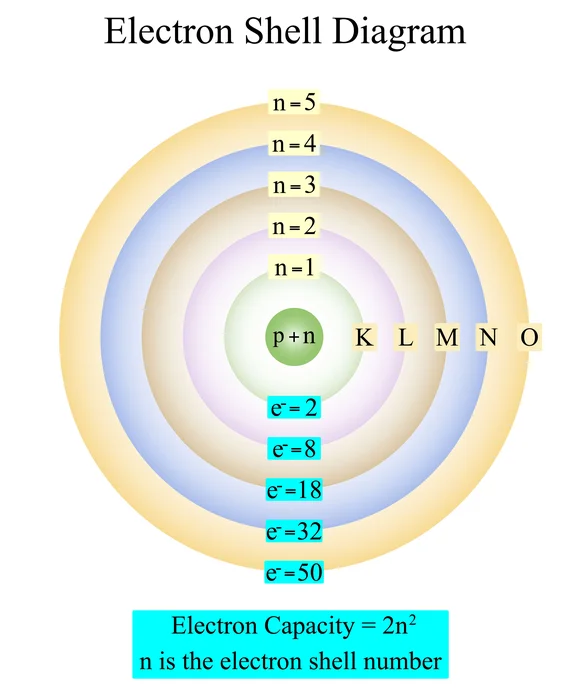
3. Shells of energy have been labelled as 1, 2, 3, 4,… or even K, L, M, N…., and so on. The energy level closest to the nucleus is denoted 1 and is known as the K shell.

4. When travelling at a certain energy level, an electron does not lose or gain energy. In such a given energy state, an electron’s energy appears to be fixed as well as stationary. This is referred to as the normal or ground state.

5. When an electron moves from one orbit to the next, it both emits and absorbs energy. When it travels from a higher energy state to a lower energy state, it releases energy, and when it travels from a lower energy state, it consumes energy.

6. Planck’s equation calculates the absorbed and released energy as the difference between the energies of the energy states.

Electron shell or a principal energy level may be thought of as an orbit followed by electrons around an atom's nucleus.

Bohr’s Atomic Model’s Limitations

1. Bohr’s concept did not explain the atomic spectrum of elements with more than one electron.

2. This does not account for the Zeeman effect, which occurs when a magnetic field breaks spectral lines into densely closed lines.

3. It also fails to illustrate the Stark effect, which occurs whenever spectral lines are broken into fine lines by an electric field.

4. According to Bohr, electrons’ circular orbits appear to be flat. However, a new study shows that an electron travels in 3 dimensions across the nucleus. Because light electrons have a dual nature, this would be centred on de Broglie’s idea.

5. Bohr’s atomic model would not adhere to Heisenberg’s uncertainty principle. According to this theory, determining the precise position and momentum of a tiny circulating particle like an electron with extreme certainty appears to be difficult. As a result, electrons follow a well-defined circular path.

6. Bohr’s hypothesis can never explain the shapes or the structure of molecules. This incorrectly considered large-sized atoms while providing sufficient information about smaller atoms.

Summary

Niels Bohr’s atomic theory includes definite-size electrons as well as energies travelling in orbits around a central nucleus, similar to how planets orbit the sun. To summarise Bohr’s atomic model, the energy states of electrons are focused on the size of such orbits. As a result, electrons in tighter orbits would have less energy. Atoms are unstable because electrons move to drive down orbits, resulting in radiation. Because the electron appears to have no lower orbit to which it can jump, an atom within the smallest orbit has now become completely stable. As a result, it was hypothesised that such an electron could move between these orbits by absorbing and losing photons.

Frequently Asked Questions

1. What exactly is the Bohr Atomic Model Theory?

Ans. Bohr was the first to discover not only that electrons revolve around the nucleus in distinct orbits, but also that the total number of electrons in an element’s outermost shell can be used to define its properties.

2. What is preventing atoms from collapsing?

Ans. The electrons of an atom are kept from collapsing within the nucleus by balancing kinetic and potential energy.

3. What is the radius of a Bohr orbit?

Ans. The Bohr radius, denoted by ‘r,’ has been defined as the mean radius of an electron’s orbit around the nucleus of an H atom in its initial state. Its radius has become a standard value, roughly equivalent to \({5.2917710^{ – 11}}m.\).

Calcination And Roasting

Introduction

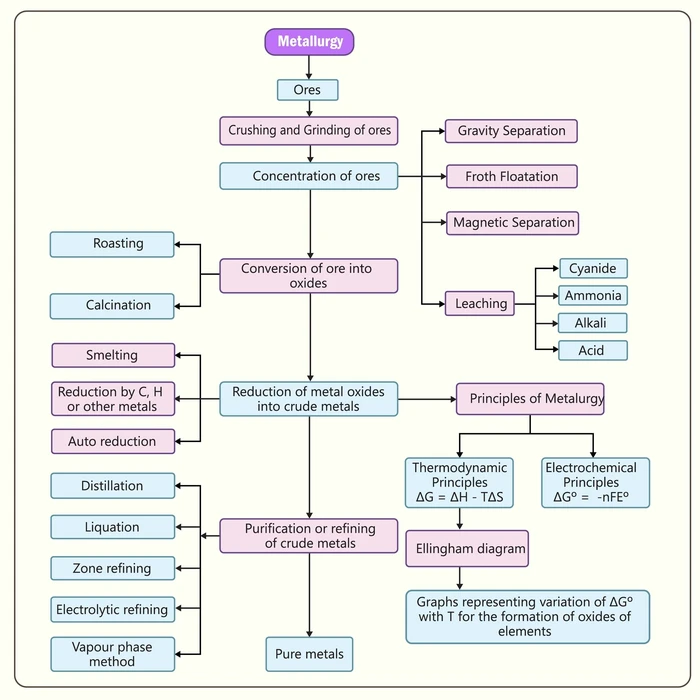
Calcination and roasting are two processes used to convert ores into oxides. Ores are a naturally occurring substance found in the earth’s crust. These ores are rich in minerals and valuable metals. Metals extracted from ore are required by applying lots of heat, either in the presence or absence of oxygen. Processes such as calcination and roasting are used to convert ores to oxides. The following is a step-by-step diagram for converting ores to oxide and extracting pure metals.

To produce oxide, raw ore is required. During this process of conversion, it expels volatile substances and gas. The removal of volatile impurities in solids and gases results in the extraction of metals from ores’ oxides. Furthermore, electrolytic refining purifies metal.

Flowchart of Metallurgy

What Exactly is Calcination?

It is the process of converting carbonate ore to oxide below its melting point using heat in the absence of air or with a limited supply of oxygen. It is also referred to as the thermal decomposition process because it decomposes ore or solid substances without changing their chemical properties and only removes volatile and organic impurities. As an example:

\[ZnC{O_3} \to {\rm{ }}ZnO{\rm{ }} + {\rm{ }}C{O_2}\]

How would you define Calcination?

Calcination is a thermal or heat process that occurs when a solid substance, such as carbonate ore, is heated above its melting point in the absence or limited supply of oxygen. Calcination is derived from the Latin word Calcinare, which means ‘to burn lime’. As a result, the most commonly used ore limestone (calcium carbonates) produces quicklime in the absence of air or oxygen at temperatures ranging from 900 to 1050 °C (calcium oxide). The following is my reaction:

\[CaC{O_3} \to {\rm{ }}CaO{\rm{ }} + {\rm{ }}C{O_2}\]

Why Calcination is Necessary

Calcination is a method of purifying ores. Heating ores or solids to temperatures well below their melting points causes the decomposition or removal of volatile impurities, moisture and water, and organic matter. As an example:

1. Carbon dioxide removal from carbonated ores.

2. Hydrated molecules are extracted from bauxite and gypsum. The following is the reaction:

\[A{l_2}S{O_3}.2{H_2}O{\rm{ }} \to {\rm{ }}A{l_2}{O_3} + {\rm{ }}2{H_2}O\]

1. The extraction of volatile liquids from petroleum and coke.

2. In the preparation of zeolites, ammonium ions are removed.

What Exactly is Roasting?

It is a process of converting mainly sulphide ores into their respective metal oxides when subjected to heat in the presence of air or oxygen. It is one of the metallurgical processes.

How would you define Roasting?

The heating process of converting sulphide ores into metal oxides below their melting point in the presence of air or oxygen is known as roasting. The conversion of ore into oxides alters the chemical properties of the solid ores and results in the formation of a new product after impurities are removed. The roasting of zinc sulphide into zinc oxide results in the following reaction:

\[2ZnS{\rm{ }} + {\rm{ }}3{O_2} \to {\rm{ }}2ZnO{\rm{ }} + {\rm{ }}3S{O_2}\]

Why Roasting is Necessary?

Roasting is a process that converts sulphide ores into oxides by heating them to high temperatures in the presence of oxygen. It is used in the metallurgy process to extract metals or their oxides from ores by removing metallic, non-metallic, toxic, and moisture impurities in the form of volatile substances. The following impurities are removed during conversion:

1. Sulphur removal from sulphide ores.

2. Phosphorus and silicon in flux are removed. Flux is used to remove impurities in the form of slag.

What are the Main Differences between Calcination and Roasting

Calcination Roasting
In the absence or limited supply of oxygen or air, the ore is heated.Heat is applied to ore in the presence of an excess of oxygen or air.
Carbonate ores are processed using this method.This method is employed for sulphide ores.
Only decomposition occurs in this process, and oxygen is not involved in the reaction.Oxygen is reacted with sulphide ores in this process.
Impurities such as organic matter and water are expelled.Toxic impurities are removed.
Carbon dioxide is produced along with metal oxide.Metal oxide and sulphur dioxide are both produced.
The process is also carried out in a reverberatory furnace. The furnace’s holes were kept closed.It is accomplished in a reverberatory furnace. The holes in the furnace were kept open to allow oxygen or air to enter.

Summary

Metals can be extracted using roasting and calcination processes. Metal-containing ores and minerals are not always present in the oxide form; in this case, roasting and calcination processes are used. Both processes convert the ore to its oxide form. This facilitates the extraction process. These only change when exposed to high temperatures. However, roasting occurs in the presence of oxygen, whereas calcination occurs in the absence of oxygen. During thermal decomposition, roasting produces new products, whereas calcination decomposes the solid substance. Both produce metal oxides, which can then be reduced to metals.

Frequently Asked Questions

1. Is there a physical process involved in calcination?

Ans. It is a decomposition process in which solid substances are broken down when high heat is applied. During this process, no new products are formed. As a result, it is only a physical change or process.

2. How do the calcination reactions take place?

Ans. Calcination reactions occur in retorts and furnaces. The ores or solid substances are stirred in this process to produce a uniform product.

3. Why are roasting and calcination done at temperatures below the melting point?

Ans. If ores are heated above their melting point, they will melt and mix with difficult-to-separate carbonate and sulphur impurities.

Coal Products

Introduction

We use a variety of materials for our necessities. Some are naturally occurring, while others are the result of human labour. Natural resources are plentiful as a result of the abundance of numerous resources in nature. Carbonization contributes significantly to global coal production. Coke is the primary by-product of high-temperature carbonization; approximately 4% of the total input coal is converted into tar and crude benzol (light oil), with significant amounts of gas also produced. The following useful products are produced by processing coal without the use of air:

1. Coal and Gas

2. Coke

3. Tar from coal

Coal and Gas

Coal gas is a combustible vapour fuel extracted from coal that is piped to customers. Town gas is a broader term for gaseous fuels produced for commercial sale and community use. In some places, it is also known as manufactured gas, syngas, or producer gas.

Depending on the techniques used to create it, coal gas is a mixture of gases such as, and, as well as volatile hydrocarbons, with minor quantities of non-caloric gases such as and as impurities.

In the nineteenth century, coal gas, which was primarily a by-product of the cooking process, was widely used for lighting, cooking, and heating. The rise in natural gas production coincided with industrialization and urbanisation, and the by-products, coal tars and ammonia, served as key chemical feedstock for the chemical industry.

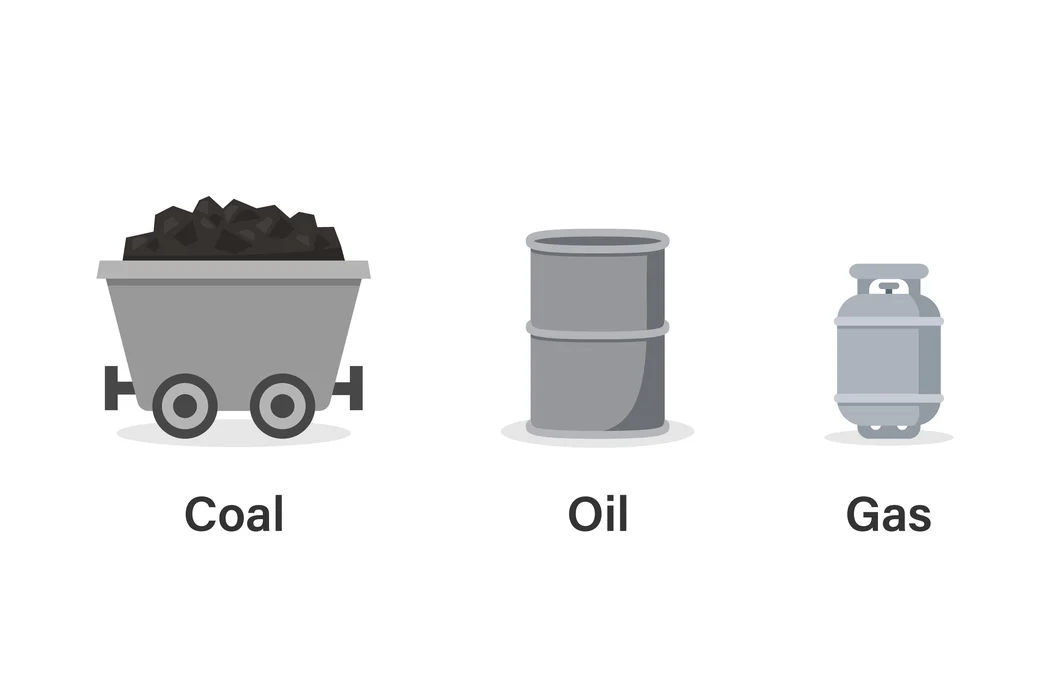
Coal, crude oil, and natural gas are all considered fossil fuels

Coal, oil, and gas production

Coal gas is produced when coal is heated in an enclosed chamber with no air.

When bituminous coal is heated to 400 °C, it relaxes and coalesces, releasing water steam, rich gas, and tar. Crude oil, coal, and gas are examples of fossil fuels. Over centuries, coal oil was produced from the remains of dead trees and other plant debris. Crude oil and natural gas were extracted from dead sea creatures.

Composition of Coal gas

Coal gas is a gaseous mixture of \({H_2}\), CO, and \({H_4}\) that is produced and used as fuel by destructive distillation (burning bituminous coal in an inert atmosphere). Steam is occasionally introduced to combine with the heated coke, increasing gas production. It is primarily composed of \({H_2}\) and \({H_4}\), with trace amounts of other hydrocarbons, carbon monoxide (a lethal gas), carbon dioxide, and nitrogen. It functions as both a fuel and an illuminant.

Uses of Coal

Coal is used for a variety of things, including

1. Electricity generation: Coal is primarily used to generate electricity. When thermal coal is burned, steam is produced, which powers turbines and generators that generate energy.

2. Liquification, as well as Gasification, is the process by which coal is burned and crushed with steam to produce town gas for home heating and lighting. It is liquefied to produce synthetic fuels that are similar to petrol and diesel.

3. Chemical, as well as other industries: Syngas can be used to create chemicals such as methanol and urea. Coal is widely used in the paper, textile, and glass industries. Coal is also used to make carbon fibre and other speciality components such as silicon metals.

Define Coke and State its Properties

Coal is distilled destructively to produce a high-carbon product. Coke is known as a virtually pure form of carbon due to its high carbon concentration. It’s a greyish-black solid that’s hard and porous. It is used as a reducing agent and a fuel in mineral extraction and steel production.

1. It has nearly pure carbon properties.

2. It is hard, porous, and black.

3. When it burns, it produces no smoke.

Uses of Coke

1. In metal extraction, it is used as a reducing agent.

2. Used in the steelmaking process.

3. It can also be used to generate energy.

Define Coal Tar and State its Properties

Coal Tar is a by-product of the coke manufacturing process. It has the same colour as coke, but it is a thick, viscous liquid with a foul odour. It is used to make synthetic colours, pharmaceuticals, fragrances, plastics, paints, and other products. Not only that, but it is also capable of producing naphthalene balls.

Coal tar was discovered in 1665 and used for medicinal purposes in the 1800s. Itchy skin, UV sensitivity, allergic reactions, and skin discolouration are all potential side effects. It’s unclear whether taking it during pregnancy is safe for the baby, and it’s not usually recommended to take it while breastfeeding.

Coal Tar Applications

Coal tar is primarily used to produce coal-tar products, as well as refined chemicals such as coal-tar pitch and creosote. Coal tar treatments have long been used to treat skin conditions such as eczema and dandruff.

Summary

Coal, as a solid carbon-rich material that is black/brown and occurs in stacked sedimentary layers, is one of the most important fossil fuels. In the future, coal liquefaction techniques could provide readily available, non-polluting fuels and chemical raw materials. Analytical criteria play a significant role in the four coal refining processes described above. Fumes, oils, and tars, as well as soluble but low-volatile extracts, pitches, and cokes, must all be investigated.

Frequently Asked Questions

1. Why do fossil fuels pollute the atmosphere?

Ans. The combustion of fossil fuels produces significant amounts of air pollution and pollutants such as \({H_2}\), CO, and \(S{O_2}\), all of which can contribute to climate change by increasing the greenhouse effect.

2. What exactly is petroleum?

Ans. Petrol, plastic, and other chemical compounds are derived from petroleum, a mineral oil found beneath the ground or in the sea. Petroleum by-products include wax, kerosene, LPG, petrol, lubricating oil, and diesel.

3. What are the different types of coal?

Ans. The least valuable and softest type of coal, with the lowest carbon concentration, is peat. Because of its high moisture content, it is unsuitable for use as fuel.

Anthracite coal is the best available. This type of coal is also known as hard coal. It contains the most carbon. It only produces a small amount of smoke.

Lignite is slightly firmer than peat, but it is still quite soft. It contains more carbon than peat.

Atomic Radius-An Overview

Introduction

The distance between the nucleus’s core and the valence shell/outermost shell, known as the atomic radius of an element, serves as a benchmark for the size of its atom. The periodic table shows that the atomic size increases as you move down it and decreases as you move from left to right. The reason for this is that as you move down the group, the number of shells increases, the screening effect multiplies, and the force of attraction weakens, causing the atomic radius to increase. Additionally, the nucleus’ protons increase as you move from left to right, drawing electrons in and shrinking the atomic radius in the process.

Basic understanding of Atomic Radius

The atomic radius is typically defined as the total distance from an atom’s nucleus to its outermost electron orbital. It can be expressed more simply as something resembling a circle’s radius, with the nucleus serving as the circle’s centre and the electron’s furthest orbital serving as the circle’s edge.

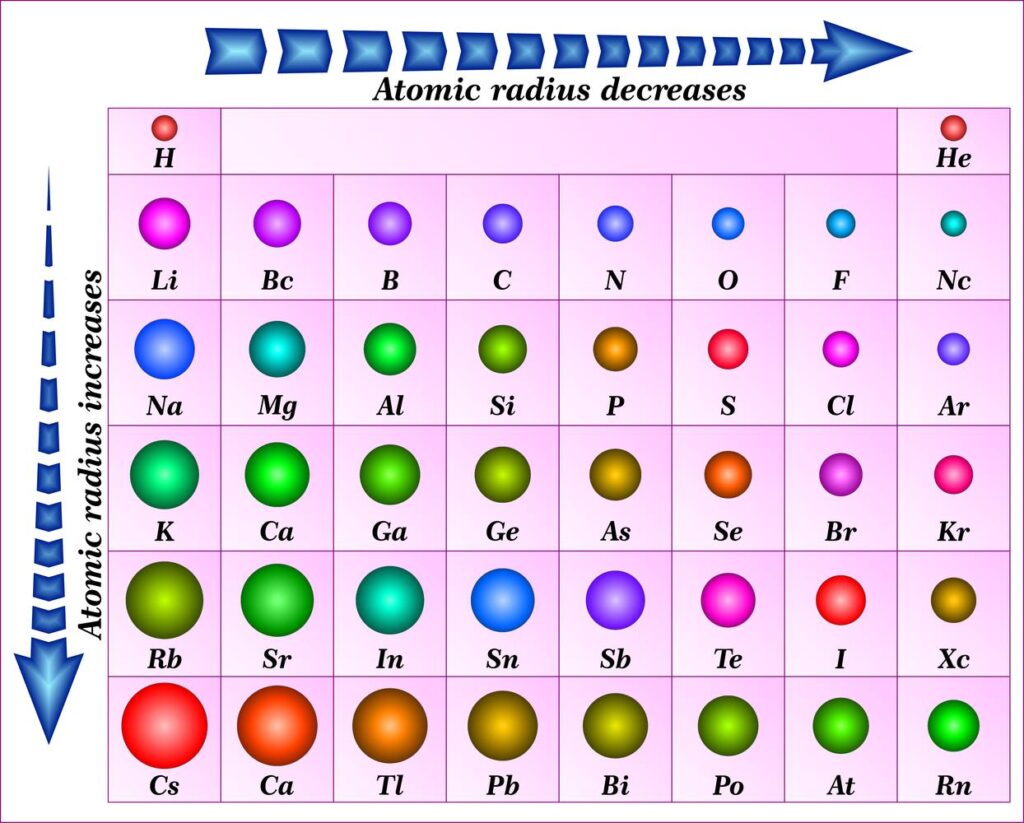
Periodic Table

What Are the Trends in Atomic Radius? Why Do They Occur?

There are two main trends in atomic radius. One atomic radius trend appears as you move across the periodic table from left to right (doing so within a period), and the other trend appears as you move from the periodic table’s top-down (moving within a group). To help you comprehend and visualise each atomic radius trend, the periodic table below includes arrows that show how atomic radii change.

1. Atomic Radius Trend 1: Atomic Radii Decrease From Left to Right Across a Period

The first atomic radius periodic trend is that as you move from left to right across a period, atomic size decreases. Each additional electron is added to the same shell within a group of elements. A new proton is also added to the nucleus when an electron is added, increasing the nuclear attraction and boosting the positive charge of the nucleus.

In other words, as protons are added, the nucleus gains a stronger positive charge, which in turn attracts the electrons more strongly and draws them in toward the nucleus of the atom. The radius of the atom decreases as the electrons are drawn inward toward the nucleus.

2. Atomic Radius Trend 2: Atomic Radii Increase as You Move Down a Group

Atomic radii rise as you descend in a group in the periodic table, which is the second atomic radius periodic trend. The atom gains an additional electron shell for every group down. The atomic radius grows as each new shell is positioned farther from the atom’s nucleus.

Contrary to popular belief, electron shielding keeps the valence electrons from the nucleus (those in the outermost shell). The electron shielding effect, which occurs when an atom has more than one electron shell, reduces the attraction of the outer electrons to the atom’s nucleus. As a result, electron shielding prevents the valence electrons from getting very close to the atom’s centre, increasing the atom’s radius.

Summary

Atomic radius is characterised by two major trends. The first periodic trend in atomic radii is the increase in atomic radius with decreasing group size. Electron shielding is the cause of this. When a new shell is added, the atomic radius grows as a result of the new electrons’ increased distance from the atom’s nucleus. More protons give an atom a stronger positive charge, which attracts electrons more strongly and pulls them toward the nucleus, shrinking the size of the atom. According to the second atomic radius periodic trend, atomic size decreases from left to right across the period.

Frequently Asked Questions

1. The atomic radius of which of the atoms-Arsenic or Selenium, is the largest?

Ans. Arsenic has a larger atomic radius than Selenium. The reason for this is that the extra protons increase the positive charge in the nucleus, which pulls the electrons closer together, reducing the radius. Arsenic along with Selenium is on the bottom row of the possibilities, but Arsenic is to the left. As a result, its atomic radius is the greatest.

2. What is the atomic radius of F and Ne in Angstrom?

Ans. The atomic radius of F and Ne in Angstrom is 0.72, 1.60. Noble gas elements quoted radii are “van der Waals radii,” which are 40 percent larger than their true atomic radii. As a result, the atomic radius of neon must be substantially larger than that of F. 

3. Is it the size of Ne or \({\bf{N}}{{\bf{a}}^ + }\) that is smaller? Why?

Ans. \(N{a^ + }\) = proton number = 10

Ne = proton number = 10

Both are isoelectronic species, meaning they have the same number of electrons and shells (10 electrons). The size will be determined by the number of protons and nuclear charge. Because the sodium ion has 11 protons, the higher the nuclear charge, the stronger the nucleus’ affinity to valence shell electrons, and the size shrinks. The size of \(N{a^ + }\) is smaller than that of Ne.

Coal Story

Introduction

Coal appears to be a dense carbon-rich substance that is brown/black and formed in layered sedimentary rock. This is one of the most important major fossil fuels. It is said to contain half of the total carbon-containing substance by weight generated by the compression and stiffening of modified plant residues, primarily peat settlements. Because of differences in plant matter, the extent of coalification, and the impurity spectrum, there are many types of coal. French explorers and fur traders discovered North American coal seams near the coast of Grand Lake in southern New Brunswick, Canada, in the 1600s. Coal deposits were discovered wherever rivers flowed deeper into the lake, but they were also excavated by hand from the surface, and caves cut into the rock. Coal is not the most abundant fossil fuel, but it has the longest history.

Breaking coal blocks with hammer

What do you understand by coal?

Coal appears to be a shiny black rock. Coal contains a tremendous amount of energy. When coal is burned, it emits both heat and light energy. The cave dwellers used coal for warmth, but ultimately for cooking. It could have been very simple to burn because it worked better than wood and did not need to be retrieved as frequently. People began using coal to heat their homes in the 1800s. Coal was used as a fuel source for both trains and ships. Nowadays, coal is primarily used to generate electricity. The four primary types or grades of coal are peat, anthracite, lignite, and bituminous coal.

What is the Coal Story?

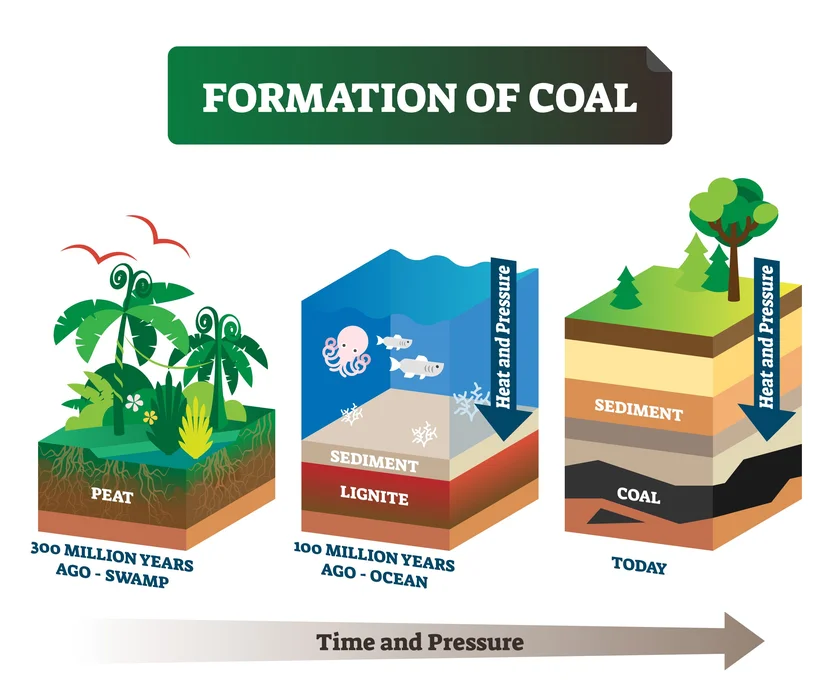
As they died, the plants sank to the bottom of the wetlands. Throughout the years, excessive amounts of vegetation have been coated in dirt and water. They had been compressed by the weight. The heat and pressure eventually converted these plants into coal. Because coal is produced by plants, and plants obtain their energy from the sun, the power in coal is also derived from the sun. Coal, as we know it today, formed over millions of years. We can’t even produce that much in such a short amount of time. This is why coal is considered non-renewable.

Process of formation of coal

How is Coal Obtained

  • This is derived from beneath deposits that are either ores coatings or are large enough to be extracted profitably.
  • Mining could be done in one of two ways: underground or open pit. The type of extraction is determined by the overall depth of such a deposit.
  • Vertical tunnels are used to access resources, whereas surface and open-pit mining remove dirt and rocks on top of mineral reserves.
  • Surface mining costs less than underground mining. As a result, surface mining is much more common.

Also Read: Coal Formation Stages

Uses of Coal

  • Coal is now used not only as a cooking fuel but also as a heat source, particularly in cold climates and developing countries. This provides a much cheaper method of cooking as well as heat production in areas where liquified petroleum gas and Biogas are not available.
  • It is frequently used as a basic component in the production of everyday commodities such as steel and iron. Coal has been used indirectly to produce steel in the steel industry.
  • It is used in a variety of industries to manufacture a wide range of products. Coal is used in a variety of industries, including cement production, paper manufacturing, chemical manufacturing, and pharmaceutical manufacturing. Coal is used by the chemical industry to produce a variety of raw materials such as benzol and sulphate of sodium.
  • Coal is used to make carbon fibre. It is the strongest and lightest element available for making stabilisers, sports equipment, and even mountain motorcycles.
  • It aids in the development of alumina mills.
  • Likewise, it could have been converted into gas or liquid, which could have been used to power vehicles such as automobiles, motorcycles, and ships.
  • Furthermore, it is primarily used as fuel in the combustion process to generate energy. Thermal coal is frequently used to generate energy in power plants.
  • Activated carbon is made from coal. Activated carbon is used in air and water purification filters, as well as renal dialysis technology.
  • Activated charcoal has been used in the production of cosmetics and facial treatments.

Summary

Coal, a carbon-rich substance that is usually black or brown, is found in multilayered rock deposits. This is one of the most important fossil fuels and can be found all over the world. For thousands of years, heat, and pressure on flora accumulated in old swampy wetlands have produced coal. Its volume, thickness, rigidity, and density all vary. It is constantly used as a fuel, an ash source, and a producer of various chemicals used in the synthesis of dyes, lubricants, and pharmaceuticals. Exploration for alternative energy sources has occasionally refocused attention on the processing of coal into liquid fuels; coal liquefaction methods were also recognised in the early twentieth century.

Frequently Asked Questions

1. What is coal’s environmental impact?

Ans. Particulate pollutants, ozone in the earth’s crust, acid rain, and smog are all environmental drawbacks of using coal as a source of energy. Fly ash granules are released into the atmosphere after coal is burned with fuel oil, causing air pollution problems.

2. What exactly is the coal formula?

Ans. The four types of coal are anthracite, bituminous, sub-bituminous, and lignite. The chemical investigation yields an empirical formula for bituminous coal, such as \({C_{137}}{H_{97}}{O_9}NS\), as well as anthracite, \({C_{240}}{H_{90}}{O_4}NS\).

3. What contaminants are present in coal?

Ans. Impurities such as sulphur and nitrogen have been discovered in coal. When coal burns, such pollutants are emitted into the atmosphere.

Ratios and Percentages

Introduction

There are several instances when ratios and percentages are employed. The proportion and ratio ideas you acquired in earlier sessions are still fresh in your mind. On a milk packet, several milk components are listed in percentages. A certain ratio of finger millet flour and wheat flour is used to make ragi bread. To dilute a fruit juice concentrate, you must add water at a specific ratio. During the building process, a predefined ratio of cement, sand, and gravel is combined. We may calculate the percentage value of a certain amount by multiplying a ratio by \({\bf{100}}\) . In a number of computations, we also employ percentages. Let’s look at percentages and ratios in this article.

Ratios

How many times one quantity is compared to another is how a ratio is defined. The ratio should be interpreted as \({\bf{a}}\) to \({\bf{b}}\) .if it contains the values \({\bf{A}}\) and \({\bf{B}}\) in the ratio \({\bf{a}}{\rm{:}}{\bf{b}}\). This ratio may also be written as a fraction, \(\frac{{\bf{a}}}{{\bf{b}}}\) . The ratios \({\bf{1}}{\rm{:}}{\bf{2}}\), \({\bf{1}}{\rm{:}}{\bf{5}}\),and \({\bf{3}}{\rm{:}}{\bf{4}}\) are a few examples. 

A ratio has two parts, antecedent and consequent. The first number is called the antecedent and the second is the consequent.

Percentage

Percentage formula

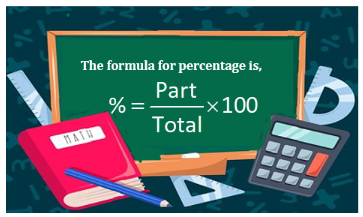
The ratio of one amount to another in terms of \({\bf{100}}\) is known as a percentage. It is a number without dimensions. The % sign is used to denote percentages.

Conversion between Ratio and Percentage

The formula below can be used to change a ratio into a percentage.

\(\%  = {\bf{Ratio}} \times {\bf{100}}\)

We may use the formula below to change a percentage into a ratio.

\({\bf{Ratio}} = \frac{{{\bf{Percentage}}}}{{{\bf{100}}}}\)  

Steps to Convert Data into Ratios and Percentage

Step one is to calculate the ratio of the questioned item to the total number of items.

Second step is format the ratio as a fraction.

Multiplying the fraction by \({\bf{100}}\) is step three.

Step four is to evaluate the percentage number by simplifying.

Example: Let there be \({\bf{28}}\) men and \({\bf{22}}\) women in a group of volunteers for a food camp drive.

Then the total number of volunteers is \({\bf{50}}\) .

We will find the ratio of men to women,

Ratio\( = {\rm{ }}{\bf{Men}}:{\bf{Women}}{\rm{ }} = \frac{{{\bf{Men}}}}{{{\bf{Women}}}} = \frac{{{\bf{28}}}}{{{\bf{22}}}} = \frac{{{\bf{14}}}}{{{\bf{11}}}} = {\bf{14}}:{\bf{11}}\)

Ratio of Men and Women to total is,

Ratio of Men \( = \frac{{{\bf{Men}}}}{{{\bf{Total}}}} = \frac{{{\bf{28}}}}{{{\bf{50}}}} = \frac{{{\bf{14}}}}{{{\bf{25}}}} = {\bf{14}}:{\bf{25}}\)

Ratio of Women\( = \frac{{{\bf{Women}}}}{{{\bf{Total}}}} = \frac{{{\bf{22}}}}{{{\bf{50}}}} = \frac{{{\bf{11}}}}{{{\bf{25}}}} = {\bf{11}}:{\bf{25}}\)

Finding the percentage of Men and Women respectively,

\(\% \) of Men\( = \frac{{{\bf{Men}}}}{{{\bf{Total}}}} \times {\bf{100}} = \) Ratio of Men\( \times {\bf{100}}\)

\( = \frac{{{\bf{14}}}}{{{\bf{25}}}} \times {\bf{100}} = {\bf{56}}\% \)

\(\% \) of Women\( = \frac{{{\bf{Men}}}}{{{\bf{Total}}}} \times {\bf{100}} = \) Ratio of Women\( \times {\bf{100}}\)

\( = \frac{{{\bf{11}}}}{{{\bf{25}}}} \times {\bf{100}} = {\bf{44}}\% \) 

Applications of Ratio and Percentage

  • When combining two ingredients, ratios can be used. For instance, combining two different types of wheat and creating solutions with various liquids.
  • Government authorities employ percentages when making some crucial choices, such those regarding assistance programms.
  • More data may be simply understood and interpreted by us.
  • Percentages are used by researchers to compare data.
  • In order to calculate profit and loss and to understand how the shares of various stakeholders in a firm contribute, businesspeople utilize percentages.
  • When developing a township or building a home, engineers allocate regions using percentages.

Difference between Ratio and Percentage

RatioPercentage
How many times one quantity is compared to another is how a ratio is defined. The ratio should be interpreted as a to b if it contains the values A and B in the ratio a:b. The ratio of one amount to another in terms of 100 is known as a percentage. It is a number without dimensions. The % sign is used to denote percentages.
Ratios are comparisons between two parts of the same thing.The percentage represents the part of the whole in terms of 100 parts, i.e., the number of sections the part has if the whole is divided into 100 sections.
Example: 1:2,  3:5 and 7:4, etc.Example: 50%, 20% and 125% etc.

Interesting Facts

  • The ratio of the Earth’s diameter to the Sun’s is \({\bf{1}}:{\bf{108}}\) .
  • To change one currency into another, one uses ratios.
  • The ratio between the heights and bases of similar triangles is \({\bf{1}}\) .

Solved Examples

Example: Find the ratio of Ravi and Suraj’s income, if Ravi earns \({\bf{40}}\% \) more than Suraj.
Ans: Let Suraj’s income be \({\bf{x}}\) .

Then Ravi’s income \( = {\bf{x}} + {\bf{40}}\% {\rm{ }}{\bf{of}}{\rm{ }}{\bf{x}}\)

\( = {\bf{x}} + \frac{{{\bf{40}}}}{{{\bf{100}}}}{\bf{x}} = \frac{{{\bf{140x}}}}{{{\bf{100}}}} = \frac{{{\bf{7x}}}}{{\bf{5}}}\)

Then the ratio of Ravi’s and Suraj’s income = Ravi’s Income: Suraj’s Income

\( = \frac{{{\bf{7x}}}}{{\bf{5}}}:{\bf{x}}\) 

\( = {\bf{7}}:{\bf{5}}\) 

Summary

In this article, we have learned about ratios and percentages. A ratio is the proportion of one quantity to another. The ratio of one quantity to another, stated in terms of \({\bf{100}}\) , is known as a percentage. For comparing amounts, we employ percentages as well as ratios.

Frequently Asked Questions

1. What are equivalent ratios?

Ans. Equivalent ratios are defined as the ratios comparing two different pair of quantities which have the same overall value, these ratios do not look the same on the first view, but on some mathematical manipulations they become exactly the same.

\({\bf{1}}:{\bf{2}},{\bf{2}}:{\bf{4}},{\bf{3}}:{\bf{6}}\) are all equivalent ratios to each other.

2. Which is more important, ratios or percentages?

Ans. To compare quantities with the whole, we use percentages and to compare two parts of the same thing we use ratios. Both have their own different use, and both are equally important for that. But we cannot compare quantities using percentages if the whole quantity is not given to us, but we can directly compare ratios to compare two parts without the knowledge of the whole. Which is why the ratios are slightly more important than percentages while comparing quantities. Whereas in practicality percentage are more easier to understand than ratios, which is why percentages are seen more often in real life examples, such as a discount of \({\bf{25}}\% \) is easier to interpret rather than saying a discount of \(\;{\bf{1}}:{\bf{4}}\).

3. What are proportions?

Ans. Proportions are a comparison between two ratios that are comparing two different pairs of quantities. They are represented by the symbol, ‘\(::\)’.

Forest Conservation and Effects of Deforestation on Environment

Introduction

Forests are essential to human life due to the diverse materials they provide. They produce oxygen, which is required for life on Earth, act as a carbon sink, and store carbon, earning them the moniker “earth lung.” Furthermore, they regulate the hydrological cycle and the global climate; purify water; provide habitat for wildlife, reduce global warming, absorb harmful gases, and perform numerous other functions. More trees are planted, and wooded areas are maintained through forest conservation to ensure their sustainability for future generations. But it has become crucial to protect forests around the world due to rising deforestation operations. Deforestation is the permanent removal or destruction of forests to make way for new agricultural, livestock, or other uses of the land.

Some reasons why forests are essential to our survival.

The sustainable production of wood and timber products, as well as the provision of food, housing, and energy, is one of the most important functions of forests. They provide critical ecosystem services for human well-being, such as-

1. Forests cover one-third of the Earth’s land area. They carry out critical tasks all over the world.

2. The forest absorbs damaging greenhouse gases that lead to climate change.

3. Forests provide clean water for drinking, bathing, and other household needs. They help to maintain the balance of oxygen, carbon dioxide, and humidity in the atmosphere.

4. Forests provide numerous environmental, economic, social, and health benefits.

5. Forest is distributing food and medication. Forests provide safety, employment, and housing for communities that rely on them.

6. Forest cover mitigates floods and other natural disasters.

7. Forests are critical in our efforts to adapt to and mitigate climate change.

8. More than half of the world’s land-based species live in forests. Woods have the most biologically diverse ecosystems on land.

9. Many of the disease-treating medications sold around the world are made directly from plants found in rainforests.

10. Forests produce rubber, lac, organic pigments, gum, resins, and other materials.

Forest conservation

Forest conservation does not imply that users should be denied access, but rather that access should be granted in a way that does not harm the environment or our economy. The following methods might be applied to preserve forests, which would eventually enhance forested areas and ensure the sustainability of the available resources:

1. Afforestation is the practice of planting trees for monetary gain. Instead of removing trees from naturally existing forests, a practice known as “afforestation” is used to establish them and use them as resources.

2. Forest fire suppression: Forest fires are the most common and lethal cause of forest loss. As a result, precautions must be taken in such cases. Making fire lanes, using fire-fighting chemicals, removing dead trees and dry leaves, and so on.

3. Addressing the root causes of deforestation: If we are to effectively expand the role of forests in providing for basic human needs, we must address the root causes of deforestation, such as poverty and the need for food, shelter, and fuel.

4. Verifying forest clearances for urbanization: In an era of rapid urbanization and industrialization, it is common practice to remove forests through encroachment or authorization. As a result, strict regulations should be put in place to prevent the urbanization of forest areas.

5. Examining the forest harvesting procedure: To ensure successful in-situ conservation of biological diversity during forest exploitation, current forest harvesting procedures should be critically evaluated by the provisions of the Convention on Biological Diversity.

girl planting the tree with shovel.

How can we protect wildlife?

Wildlife conservation refers to the process of protecting plant and animal species as well as their habitats. Wildlife conservation is a response to the century’s steadily increasing rate of extinction. Humans are to blame for the current rate of species extinction. However, we remain optimistic that we can save our species by taking a few critical steps. These are

1. Speak up for wildlife: your voice matters! Encourage your state and federal representatives to support wildlife protection legislation in writing.

2. Planting native plants is a great way to make our yards more wildlife-friendly. This provides food, shelter, and a place for wild animals to raise their families.

3. Ecosystem protection: One of the simplest and most effective ways to help wildlife is to preserve the environment in which it lives. The three major environmental conservation methods are to reduce, reuse, and recycle.

4. Be an informed consumer: Avoid using items that endanger wildlife and their habitats, such as non-recycled paper products, gas-guzzling cars, and so on.

5. Preserving endangered species: The Endangered Species Act has proven to be a successful safety net for threatened species, saving more than 98 percent of the animals it has cared for from extinction.

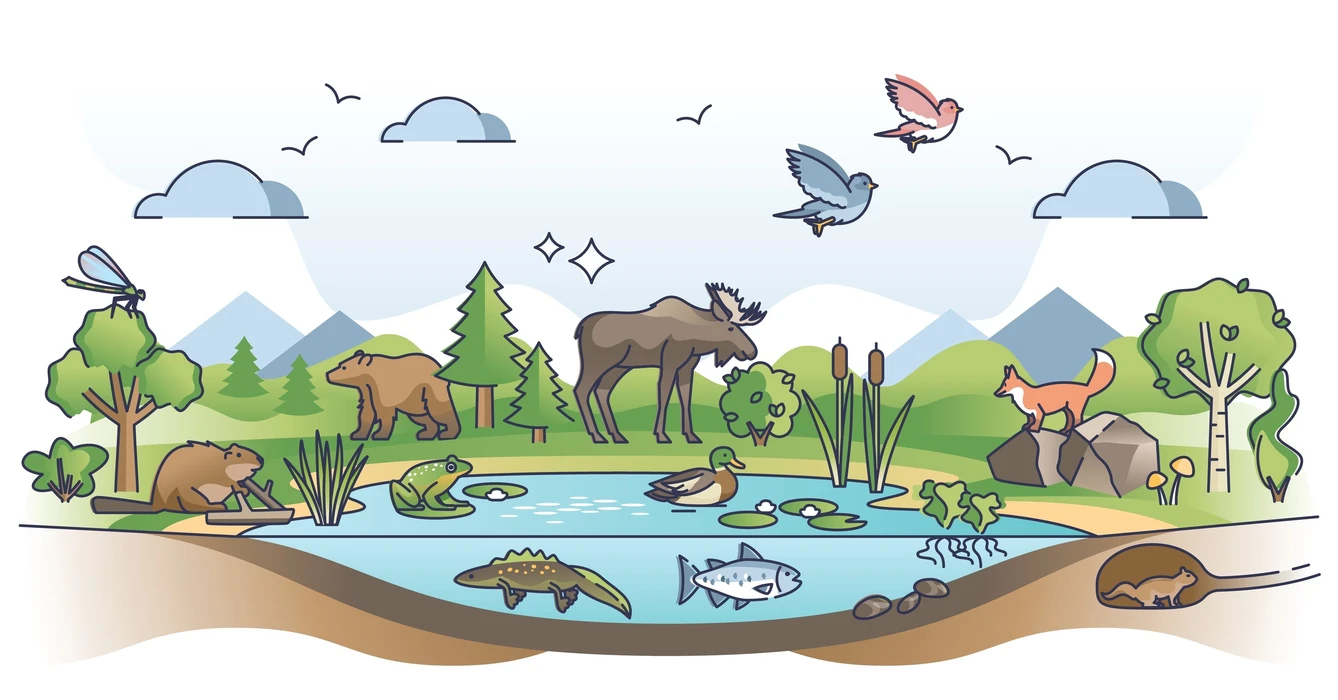
Forest Flora and Fauna image

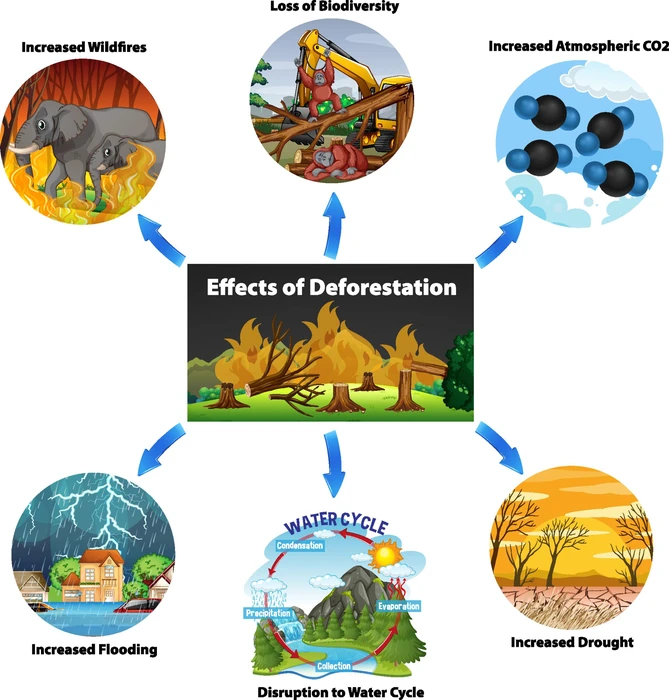
What if all the forests are destroyed?

It is impossible to imagine our existence without forests. The following are some consequences of destroying the entire forest:

1. The amount of  in the \(C{O_2}\) atmosphere will increase. As a result, the Earth’s temperature will rise.

2. Many animals and plants are losing their natural habitats. If they cannot find a suitable environment to live in, they may eventually die or become extinct.

3. The soil dries out without trees, and the water cycle is disrupted. Rain will cause flooding because the land cannot hold the water.

4. We will not receive valuable forest products. Tribal members may also lose their source of income.

effects of defforestation with image diagrams

Summary

More trees are planted, and wooded areas are maintained through forest conservation to ensure the sustainability of wooded regions for future generations. We can rely on forests for shelter, work, water, food, and fuel security, among other things. The practice of preserving plant and animal species, as well as their habitats, is known as wildlife conservation. We, humans, have a responsibility to protect our species by taking a few key actions.

Frequently Asked Questions

1. What are the negative consequences of deforestation?

Ans. In addition to harming the environment, society, and especially the climate, biodiversity, and poverty, deforestation has a negative economic impact.

2. What exactly is the Global Forest Carbon Mechanism (GFCM)?

Ans. The Global Forest Carbon Mechanism is a financial structure that would reward developing countries for reducing their emissions.

3. How can we ensure food security while also halting deforestation?

Ans. The increased agricultural output should be achieved without cutting down more trees. Better land design and significant investment are required to increase yields on existing farmland.

Chemical Equation Reactants And Products

Introduction

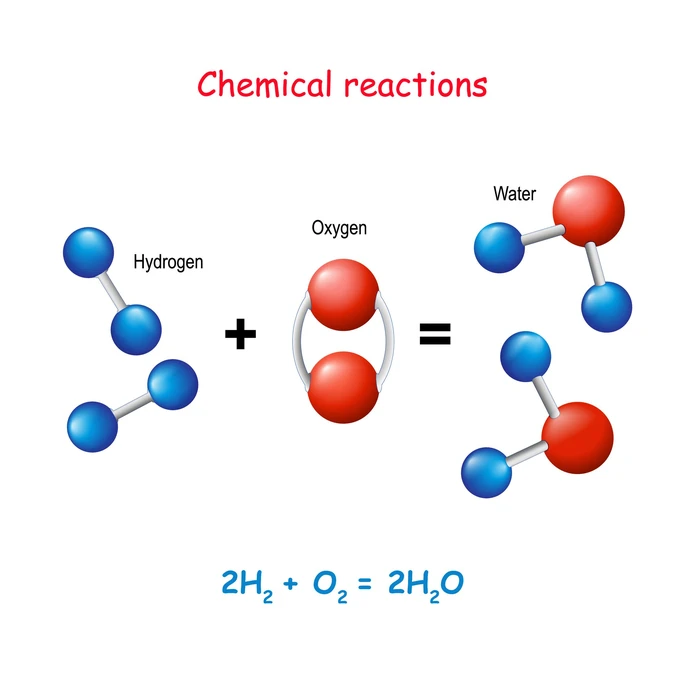
Old chemical bonds are cleaved in a chemical reaction and form new bonds. Any chemical equation should be balanced properly. It means the number of each atom should be the same on both the reactant and product sides. It is based on two rules; the ‘law of conservation of masses’ and the ‘law of constant proportions’. If a reaction is considered to be \(X + Y{\rm{ }} \to {\rm{ }}Z + P\), then X, Y are called reactants, and Z, P are called products of this reaction.

Image of Hydrogen and oxygen combining chemically to form a new molecule

Define the law of conservation of mass.

It is stated in this law: “The mass in an isolated system can neither be created nor be destroyed but can be transformed from one form to another”. So the number of each type of atom in a chemical equation is always the same on both sides of the equation.
Read More: Law of Conservation of Mass with Experimental

Define the law of constant proportions.

The law states that- “In a chemical substance, the elements are always present in definite proportions by mass”. In the \({H_2}O\) molecule, the molar mass of two H atoms is 2 gm/mole and the molar mass of one O atom is 16 gm/mole. So their ratio of mass is 2:16=1:8. This ratio in \({H_2}O\) is always constant.

What is a balanced chemical equation?

According to the two laws of conservation of mass and conservation of definite proportions, a chemical equation must be properly balanced. It means that the number of all the atoms or molecules involved in a chemical reaction must be the same on both the reactant and product side. This is known as a balanced chemical equation. 

Importance of coefficients and subscripts in balancing a chemical equation

Coefficients are numbers that help us to determine the number of each atom present in a balanced chemical equation. It can be changed necessarily.

Subscripts are the numbers that help to determine the chemical formula of any compound. The subscripts are always constant throughout a chemical equation.

\[{N_2} + {\rm{ }}3{\rm{ }}{H_2} \to {\rm{ }}2{\rm{ }}N{H_3}\]

Method of generating a balanced chemical equation- 

Suppose we are trying to balance this unbalanced chemical equation. 

\[C{H_4} + {O_2} \to {\rm{ }}C{O_2} + {H_2}O\]

These are the steps that are followed to make a balanced chemical equation. 

  • At first, the number of each atom on both sides is determined.
Atoms presentNumber of atoms on the reactants sideNumber of atoms on the products side
C11
O23
H42
  • Then coefficients of each atom are balanced properly. For this equation, at first, the coefficients of H are balanced. So now the chemical equation transforms into- 

\[C{H_4} + {O_2} \to {\rm{ }}C{O_2} + 2{\rm{ }}{H_2}O\]

  • Now the coefficient of O is balanced accordingly. So the new chemical equation is:

\[C{H_4} + 2{O_2} \to {\rm{ }}C{O_2} + 2{H_2}O\]

This is the balanced chemical equation: \(C{H_4} + 2{O_2} \to {\rm{ }}C{O_2} + 2{H_2}O\)

Balancing the chemical equation- 

\[{C_3}{H_8} + {O_2} \to {\rm{ }}C{O_2} + {H_2}O\]

  • At first, the number of each atom on both sides is determined.
Atoms presentNumber of atoms on the reactants sideNumber of atoms on the products side
C31
O23
H82
  • Now the coefficient of C is balanced on both sides. So the chemical equation changes to-

\[{C_3}{H_8} + {O_2} \to {\rm{ }}3C{O_2} + {H_2}O\]

After equating the coefficients of H, the new equation is:

\[{C_3}{H_8} + {O_2} \to {\rm{ }}3C{O_2} + 4{H_2}O\]

  • Then the coefficients of O are balanced accordingly to form a balanced chemical equation.

\[{C_3}{H_8} + 5{O_2} \to {\rm{ }}3C{O_2} + 4{H_2}O\]

This is the balanced chemical equation: \({C_3}{H_8} + 5{O_2} \to {\rm{ }}3C{O_2} + 4{H_2}O\)

In this way, any chemical equation can be balanced.

Summary

According to the laws of conservation of mass and conservation of constant proportions, any chemical equation should be balanced properly. This is done by equating the coefficients of each atom involved in a chemical reaction. Balancing a chemical equation is extremely important in the field of chemistry. Based on the coefficients present before the molecules involved in a chemical equation, the yield of the products of that reaction can be determined.                                         

Frequently Asked Questions

1. State the limitations of using chemical equations.

Ans: By any chemical equation we can’t understand the states(solid/liquid/gas) of the compounds involved. Again, the reversibility or irreversibility of any reaction can’t be determined by the chemical equation. 

2. What are the different types of chemical equations?

Ans: Depending on the nature of reactants and products in a reaction, it may be classified into five types. They are combination reaction, single replacement reaction, decomposition reaction, combustion reaction, and double replacement reaction. Some reactions fall under two categories simultaneously. 

3. What is the main reason behind a chemical reaction?

Ans: A chemical reaction can be described as a bond-breaking and bond-making process. It means all the old bonds are cleaved and new bonds are formed. The molecules which react in a chemical reaction are called reactants and the molecules produced in a reaction are called products. 

Role of women in the French Revolution

Introduction

In European history, the French Revolution was a revolutionary movement that brought about profound societal and political changes. The role that women played in the revolution was amazing. Women’s participation was only allowed in the domestic sphere before the Revolution or during its early years. They all desired, though, to air their concerns and political beliefs and take part in public life like men. In addition to their responsibilities to their families, women were drawn to the idea of equality and fraternity. Through various forms of action, women gradually began to unite and demand equal rights. They wanted to be in control of their destiny and would not accept being treated as passive second-class citizens.

Traditional Duties of Women

  • Before the French Revolution began in the eighteenth century, women were viewed as second-class citizens. They were not given any political rights or a recognized role in society.
  • Men made all the significant decisions on their behalf. Before they got married, their fathers made decisions for them. After being married, their husbands made all of their decisions.
  • Even the enlightenment-era progressive writers were opposed to women’s political rights. No property rights of any kind were granted to women.
  • They were still viewed as purely sexual beings, which made them very distinct from their male counterparts and perfectly suited for domestic settings.
  • Although third estate women were not allowed to receive a formal education, they continued to labor in tailoring shops, laundries, or as maids in the homes of the wealthy to make a living.
  • Before the revolution began, women from the upper class participated in gatherings called salons to explore novel concepts regarding education, individual rights, and other social issues.
  • Like their male counterparts, French aristocrats or ministers, they had the benefit of receiving a formal education and were regarded as intellectuals. Although, they still lacked the legal authority to engage in public life.

Revolutionary Activism of Women

Many of these women from various social strata rushed to the streets to express their rage once the uprising began, capitalizing on the tumultuous political climate.

Women’s March

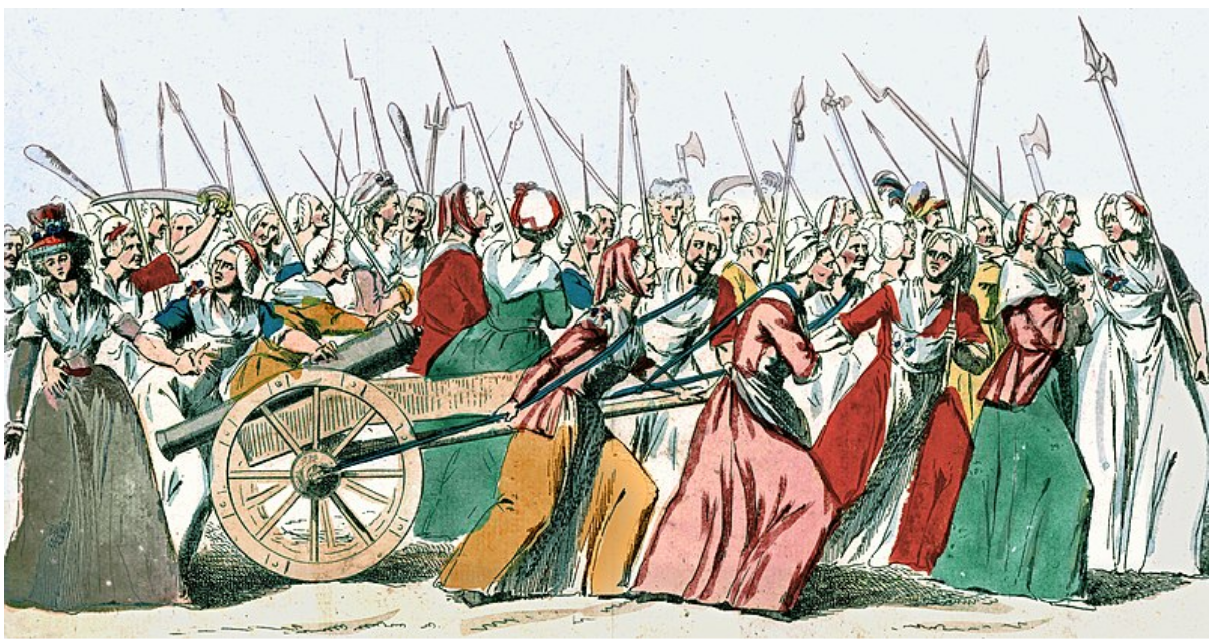
In 1792, many women marched in a parade carrying weapons through the Legislative Assembly’s chambers and onto the Tuileries Gardens before arriving at the Monarch’s home after learning that the King was planning a counter-revolution. The high cost of cereals and the scarcity of bread had thousands of women in an uproar. At the infamous Women’s March on Versailles, which drew more than 60,000 women, the demands of feminist revolutionaries Théroigne de Méricourt and Pauline Leon for women’s full citizenship and the economic crisis were interwoven. Nevertheless, the call for women to be granted citizenship was ignored.

This image shows the Women's march in 1792.

Newspapers and Social Groups

Whatever the circumstances, women could not be barred from participating in public life during a revolution. The French Revolution also had a large element of individual women’s revolutionary participation. A periodical published by Nicolas de Condorcet supported the call for women’s political rights. A group called Cercle Social was eventually founded by this publication to promote equal rights for women in marriage and education. It was led by a Dutchwoman named Etta Palm d’Aelders.

Activism through Writing

Through their writings, women writers also expressed their discontent. To prove that the government had been depriving women of rights since the dawn of time, Olympe de Gouges issued a document in 1791 called “Declaration of the Rights of Woman” that used language and a structure similar to the “Declaration of the Rights of Man and Citizen.” She paid a terrible price for her advocacy by being put to death by the guillotine.

Political Organization of Women

Women’s revolutionary activism extended beyond simple street protests and demonstration planning. To show their unwavering support for the Republic, Leon, and her ally Claire Lacombe founded the Society of Revolutionary Republican Women in 1793. They did this by donning tricolored symbols, protesting the high price of bread, stockpiling grains, and eventually bringing down the price increase. When their demands were not met, they quickly turned to riot, looting stores, grabbing food that had been hoarded, and kidnapping police officers.

Banning and Execution of Women Activists

The men in the revolution, meanwhile, were against women’s equal rights. The Revolutionary Republican Women were being demonized as dangerous agitators while they were ruling the Jacobins. The ladies were sent home to look for their children and homes. Men reminded them that women were made by nature to bear and raise children. They cannot acquire citizenship rights. Their proper setting is the home, while men belong in the public sphere. Political power can only be used by men. Most of the female activists who were punished suffered detention, arrest, execution, or exile.

Summary

Women played a spectacular and important role in the French Revolution. Participating in the revolution were women from every social group and class. By taking part in the protest, speaking out about economic difficulties, founding political clubs to demand their rights, publishing newspapers, and creating plays, women exposed how they were being denied their rights. Women actively participated in the revolution despite knowing the outcome of their activity. Women gained the rights to education, marriage consent, and divorce with the establishment of the Revolutionary government.

Frequently Asked Questions

1. Who were the Jacobins?
Ans. Members of the political group known as the Jacobin Club were known as Jacobins. It was a well-known club during the French Revolution and a revolutionary political organization. They adhered to the constitution, which protected natural rights and upheld human rights.

2. Who killed the Jacobin leader Jean-Paul Marat? Why?
Ans. On July 13, 1793, Charlotte Corday assassinated Jean-Paul Marat, the leader of the Jacobins. The publication “The Friend of the People,” published by the Jacobin leader Jean-Paul Marat, severely criticized those who questioned the Revolution’s shift toward violence, threats, and other forms of aggressiveness.

3. Who was Marie Antoinette? What was her role in Monarchical rule in France?
Ans. After marrying King Louis XVI of France, Marie Antoinette assumed the role of queen of France. Because of her opposition to progressive reform ideas, Marie Antoinette became notorious among the French populace. Her popularity is thought to have contributed significantly to the French monarchy’s downfall.